
PCNSE · Question #485
A user at an internal system queries the DNS server for their web server with a private IP of 10.250.241.131 in the webserver. The DNS server returns an address of the web server's public address…
The correct answer is D. NAT Rule. To allow internal users to access an internal web server using its public IP address (U-Turn NAT), the firewall must implement a NAT rule to translate both source and destination IPs, alongside a security policy to permit the internal-to-internal traffic.
Question
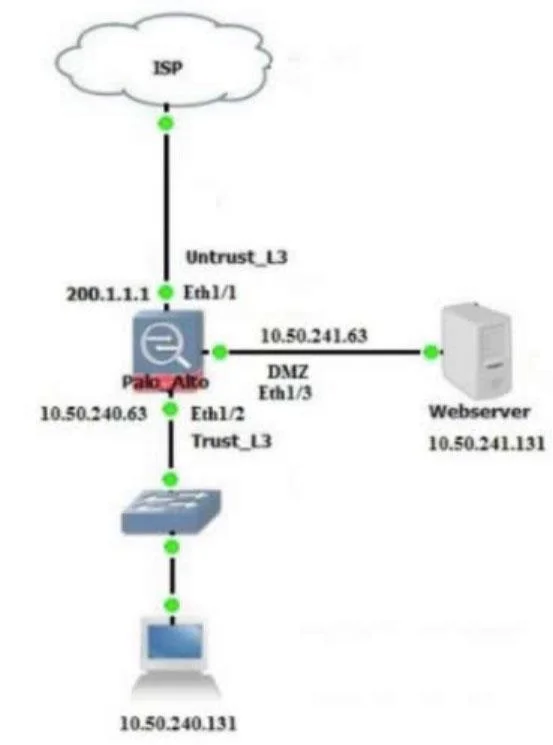
A user at an internal system queries the DNS server for their web server with a private IP of 10.250.241.131 in the webserver. The DNS server returns an address of the web server's public address 200.1.1.10. In order to reach the web server, which security rule and U-Turn NAT rule must be configured on the firewall?
Exhibit
Options
- ANAT Rule:
- BNAT Rule:
- CNAT Rule:
- DNAT Rule:
How the community answered
(42 responses)- A14% (6)
- B5% (2)
- C7% (3)
- D74% (31)
Why each option
To allow internal users to access an internal web server using its public IP address (U-Turn NAT), the firewall must implement a NAT rule to translate both source and destination IPs, alongside a security policy to permit the internal-to-internal traffic.
Without the specific rule configurations for option A, it is impossible to provide a technical reason why it is incorrect; however, common misconfigurations for U-Turn NAT often involve incorrect source or destination zone definitions, improper destination IP translation, or missing source NAT, which would prevent successful communication.
Without the specific rule configurations for option B, it is impossible to provide a technical reason why it is incorrect; however, an incorrect NAT rule could fail to address the U-Turn scenario by not translating the destination IP to the private address or by not performing SNAT, leading to asymmetric routing or connection failures.
Without the specific rule configurations for option C, it is impossible to provide a technical reason why it is incorrect; however, an improperly configured security policy, such as one with incorrect source/destination zones or services, would block the U-Turn NAT traffic even if the NAT rule itself was correct.
For U-Turn NAT, the NAT rule (D, representing the correct configuration) must specify the source and destination zones as internal, translate the destination IP from the public address (200.1.1.10) to the private address (10.250.241.131) of the web server, and typically employ Source NAT (SNAT) to translate the internal user's source IP to an IP on the firewall's internal interface. Concurrently, a security policy allowing traffic from the internal zone to the internal zone, targeting the web server's private IP, is essential to permit this communication.
Concept tested: U-Turn NAT and Security Policy Configuration
Source: https://docs.paloaltonetworks.com/pan-os/10-2/pan-os-admin/nat/nat-configuration/configure-nat-for-internal-hosts-accessing-internal-servers
Topics
Community Discussion
No community discussion yet for this question.