
PCCSE · Question #38
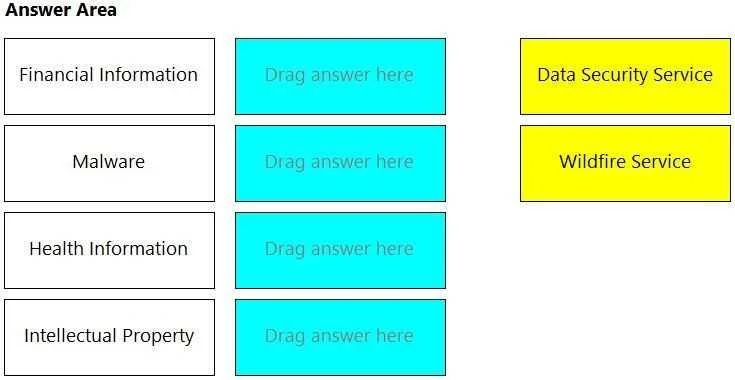
Drag and Drop Question Match the service on the right that evaluates each exposure type on the left. (Select your answer from the pull-down list. Answers may be used more than once or not at all.)…
The correct answer is Financial Information - Data Security Service; Malware - Wildfire Service; Health Information - Data Security Service; Intellectual Property - Data Security Service. The question tests the ability to correctly match different exposure types to the appropriate security services, distinguishing between data protection and malware analysis.
Question
Drag and Drop Question Match the service on the right that evaluates each exposure type on the left. (Select your answer from the pull-down list. Answers may be used more than once or not at all.) Answer:
Exhibit
Answer Area
Drag items
Correct arrangement
- Financial Information - Data Security Service
- Malware - Wildfire Service
- Health Information - Data Security Service
- Intellectual Property - Data Security Service
Explanation
The question tests the ability to correctly match different exposure types to the appropriate security services, distinguishing between data protection and malware analysis.
Approach. The correct interaction is to drag 'Data Security Service' to 'Financial Information', 'Health Information', and 'Intellectual Property', and drag 'Wildfire Service' to 'Malware'.
- Financial Information: This is sensitive data that requires comprehensive protection, including data loss prevention (DLP), encryption, and access control, all typically covered by a Data Security Service.
- Malware: The Wildfire Service (a common name for cloud-based threat analysis services, specifically Palo Alto Networks' advanced threat prevention cloud) specializes in identifying and analyzing unknown malware and exploits using sandboxing and dynamic analysis techniques.
- Health Information: This is highly sensitive and regulated data (e.g., HIPAA, GDPR) that requires robust data security measures, including DLP, data classification, and compliance controls, which fall under a Data Security Service.
- Intellectual Property: Proprietary data that needs protection from theft or unauthorized disclosure, also requiring capabilities like DLP, access controls, and data classification, all components of a Data Security Service.
Common mistakes.
- common_mistake. A common mistake would be to misinterpret the scope of 'Wildfire Service' or 'Data Security Service'. Assigning 'Wildfire Service' to sensitive data types like 'Financial Information' or 'Health Information' would be incorrect because Wildfire's primary function is threat detection and analysis for malicious code, not the direct protection or compliance of sensitive data itself. Conversely, assigning 'Data Security Service' to 'Malware' would be incorrect because while data security services contribute to an overall security posture, a dedicated threat analysis service like Wildfire is specifically designed to evaluate and prevent malware infections. Another mistake might be to assume that Data Security Service is too generic for these specific data types; however, it's an umbrella term encompassing all the necessary controls for protecting sensitive information.
Concept tested. The core concept being tested is the understanding of different cybersecurity services and their specific functions, particularly distinguishing between services focused on data protection and compliance (Data Security Service) and those focused on advanced threat detection and malware analysis (Wildfire Service/sandboxing). It also tests knowledge of various data types and their associated security requirements.
Topics
Community Discussion
No community discussion yet for this question.