
NSE7_PBC-7.2 · Question #34
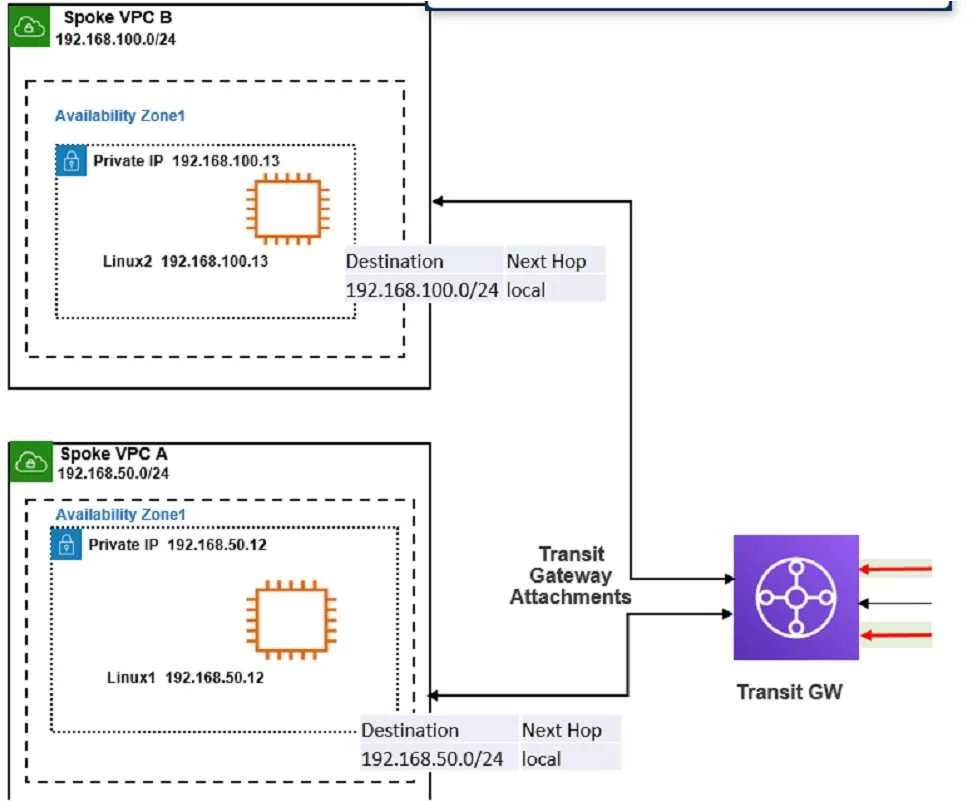
Refer to the exhibit. The exhibit shows a customer deployment of two Linux instances and their main routing table in Amazon Web Services (AWS). The customer also created a Transit Gateway (TGW) and…
The correct answer is C. In the TGW route table, associate two attachments. D. In the main subnet routing table in VPC A and B, add a new route with destination 0.0.0.0/0. According to the AWS documentation for Transit Gateway, a Transit Gateway is a network transit hub that connects VPCs and on-premises networks. To route traffic from Linux instances to the TGW, you need to do the following steps: In the TGW route table, associate two…
Question
Refer to the exhibit. The exhibit shows a customer deployment of two Linux instances and their main routing table in Amazon Web Services (AWS). The customer also created a Transit Gateway (TGW) and two attachments. Which two steps are required to route traffic from Linux instances to the TGWQ (Choose two.)
Exhibit
Options
- AIn the TGW route table, add route propagation to 192.168.0.0/16
- BIn the main subnet routing table in VPC A and B, add a new route with destination 0.0.0.0/0,
- CIn the TGW route table, associate two attachments.
- DIn the main subnet routing table in VPC A and B, add a new route with destination 0.0.0.0/0,
How the community answered
(40 responses)- A5% (2)
- B13% (5)
- C83% (33)
Explanation
According to the AWS documentation for Transit Gateway, a Transit Gateway is a network transit hub that connects VPCs and on-premises networks. To route traffic from Linux instances to the TGW, you need to do the following steps: In the TGW route table, associate two attachments. An attachment is a resource that connects a VPC or VPN to a Transit Gateway. By associating the attachments to the TGW route table, you enable the TGW to route traffic between the VPCs and the VPN. In the main subnet routing table in VPC A and B, add a new route with destination 0.0.0.0/0, next hop TGW. This route directs all traffic from the Linux instances to the TGW, which can then forward it to the appropriate destination based on the TGW route table.
Topics
Community Discussion
No community discussion yet for this question.