
NSE4 · Question #453
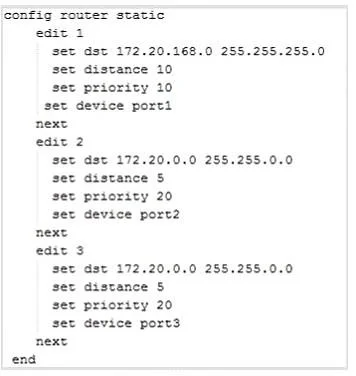
The exhibit shoes three static routes. Which routes will be used to route the packets to the destination IP address 172.20.168.1?
The correct answer is D. Only the route with the ID number 1. FortiGate routing decisions are based on the longest prefix match, meaning the most specific route to a destination IP address will always be chosen.
Question
The exhibit shoes three static routes. Which routes will be used to route the packets to the destination IP address 172.20.168.1?
Exhibit
Options
- AThe route with the ID number 2 and 3.
- BOnly the route with the ID number 3.
- COnly the route with the ID number 2.
- DOnly the route with the ID number 1.
How the community answered
(62 responses)- A3% (2)
- B13% (8)
- C5% (3)
- D79% (49)
Why each option
FortiGate routing decisions are based on the longest prefix match, meaning the most specific route to a destination IP address will always be chosen.
Routes 2 (172.20.168.0/22) and 3 (172.20.0.0/16) are less specific than route 1 (172.20.168.0/24) for the destination 172.20.168.1, and thus will not be chosen.
Route 3 (172.20.0.0/16) is the least specific of the options and would only be chosen if no more specific route existed for the destination 172.20.168.1.
Route 2 (172.20.168.0/22) is less specific than route 1 (172.20.168.0/24) and would not be selected for the destination 172.20.168.1.
The route with ID number 1 (172.20.168.0/24) is the most specific route matching the destination IP address 172.20.168.1 because its /24 prefix is longer than /22 or /16, ensuring it will be used according to the longest prefix match rule.
Concept tested: Longest prefix match routing (FortiGate)
Source: https://docs.fortinet.com/document/fortigate/7.4.0/administration-guide/994432/static-routes
Topics
Community Discussion
No community discussion yet for this question.