
NSE4 · Question #311
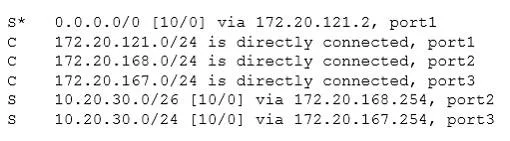
View the example routing table. Which route will be selected when trying to reach 10.20.30.254?
The correct answer is C. 10.20.30.0/24 [10/0] via 172.20.167.254, port3. The routing process selects the most specific route, identified by the longest prefix match, that covers the destination IP address.
Question
View the example routing table. Which route will be selected when trying to reach 10.20.30.254?
Exhibit
Options
- A10.20.30.0/26 [10/0] via 172.20.168.254, port2
- BThe traffic will be dropped because it cannot be routed.
- C10.20.30.0/24 [10/0] via 172.20.167.254, port3
- D0.0.0.0/0 [10/0] via 172.20.121.2, port1
How the community answered
(37 responses)- A3% (1)
- B14% (5)
- C78% (29)
- D5% (2)
Why each option
The routing process selects the most specific route, identified by the longest prefix match, that covers the destination IP address.
The destination IP 10.20.30.254 is not within the 10.20.30.0/26 network range (which ends at 10.20.30.63), so this route would not be matched.
The traffic can be routed because both the 10.20.30.0/24 route and the default route 0.0.0.0/0 match the destination IP, with the more specific one being chosen.
The destination IP address 10.20.30.254 falls within the 10.20.30.0/24 network, and this route is more specific (longer prefix) than the default route 0.0.0.0/0.
The 0.0.0.0/0 route is the default route, which is less specific (shorter prefix) than the 10.20.30.0/24 route, so it would only be used if no more specific route matches.
Concept tested: Longest prefix match routing
Source: https://docs.fortinet.com/document/fortigate/7.4.0/administration-guide/469905/routing
Topics
Community Discussion
No community discussion yet for this question.