
NSE4 · Question #328
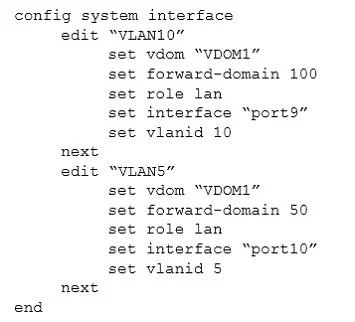
An administrator has configured two VLAN interfaces: A DHCP server is connected to the VLAN10 interface. A DHCP client is connected to the VLAN5 interface. However, the DHCP client cannot get a…
The correct answer is D. Both interfaces must belong to the same forward domain. For a DHCP client on one VLAN interface to receive an IP address from a DHCP server on another VLAN interface managed by the same FortiGate, both VLAN interfaces must belong to the same forward domain to allow Layer 2 broadcast communication if part of a virtual switch.
Question
An administrator has configured two VLAN interfaces:
A DHCP server is connected to the VLAN10 interface. A DHCP client is connected to the VLAN5 interface. However, the DHCP client cannot get a dynamic IP address from the DHCP server. What is the cause of the problem?
Exhibit
Options
- ABoth interfaces must be in different VDOMs
- BBoth interfaces must have the same VLAN ID.
- CThe role of the VLAN10 interface must be set to server.
- DBoth interfaces must belong to the same forward domain.
How the community answered
(25 responses)- A4% (1)
- B4% (1)
- C12% (3)
- D80% (20)
Why each option
For a DHCP client on one VLAN interface to receive an IP address from a DHCP server on another VLAN interface managed by the same FortiGate, both VLAN interfaces must belong to the same forward domain to allow Layer 2 broadcast communication if part of a virtual switch.
Both interfaces being in different VDOMs would further isolate them and prevent DHCP communication without specific inter-VDOM links or routing.
VLAN interfaces are typically distinct Layer 2 segments identified by their VLAN ID; having the same VLAN ID would not create two distinct VLAN interfaces as described.
The role of a FortiGate interface (e.g., LAN, WAN) does not dictate its ability to function as a DHCP server or client; the issue is connectivity, not the interface's functional role.
In a FortiGate, if VLAN interfaces are configured within a virtual switch, they must belong to the same forward domain to share the same Layer 2 broadcast domain. DHCP relies on Layer 2 broadcasts, so if the client and server's VLAN interfaces are in different forward domains within a virtual switch, DHCP broadcasts cannot cross, preventing the client from receiving an IP address.
Concept tested: FortiGate forward domains and DHCP communication
Source: https://docs.fortinet.com/document/fortigate/7.4.0/administration-guide/526710/setting-the-interface-role
Topics
Community Discussion
No community discussion yet for this question.