
MS-900 · Question #391
Hotspot Question Instructions: For each of the following statements, select Yes if the statement is true. Otherwise, select No. NOTE: Each correct selection is worth one point. Answer:
The correct answer is A retention policy is an example of information governance in Microsoft 365. = Yes; Managing inactive mailboxes is an example of information governance in Microsoft 365. = Yes; Creating a new Exchange throttling policy is an example of information governance in Microsoft 365. = No. A retention policy and managing inactive mailboxes are core examples of Microsoft 365 information governance, whereas Exchange throttling policies are operational, not governance-related.
Question
Exhibit
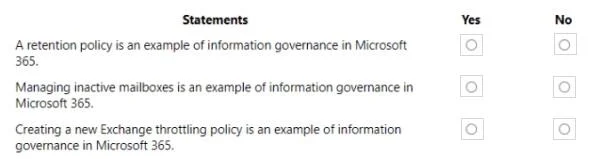
Answer Area
- A retention policy is an example of information governance in Microsoft 365.Yes
- Managing inactive mailboxes is an example of information governance in Microsoft 365.Yes
- Creating a new Exchange throttling policy is an example of information governance in Microsoft 365.No
Explanation
A retention policy and managing inactive mailboxes are core examples of Microsoft 365 information governance, whereas Exchange throttling policies are operational, not governance-related.
Approach. To correctly answer this question, the test-taker must understand the definition and scope of 'information governance' within Microsoft 365. Information governance encompasses policies and practices related to the lifecycle management of information, including its creation, storage, use, retention, and disposition, typically for compliance, legal, and business value purposes.
-
Statement 1: 'A retention policy is an example of information governance in Microsoft 365.' Select Yes. Retention policies are a cornerstone of information governance. They define how long data (e.g., emails, documents, Teams messages) should be retained and when it should be deleted to meet organizational, legal, and regulatory compliance requirements. This directly manages the information lifecycle.
-
Statement 2: 'Managing inactive mailboxes is an example of information governance in Microsoft 365.' Select Yes. When an employee leaves an organization, their mailbox can be made 'inactive' to preserve its content for compliance, legal hold, or eDiscovery purposes, even after the user account is removed. This process ensures that vital information is retained according to governance policies without requiring an active license, directly supporting data lifecycle management and compliance.
-
Statement 3: 'Creating a new Exchange throttling policy is an example of information governance in Microsoft 365.' Select No. Exchange throttling policies are operational controls designed to manage and limit the consumption of Exchange server resources by users or applications. Their purpose is to ensure system stability, performance, and fair resource allocation, preventing abuse or overload. They do not directly govern the content, retention, or lifecycle of information itself; rather, they manage the infrastructure supporting that information.
Common mistakes.
- common_mistake. Common mistakes stem from a misunderstanding of what constitutes 'information governance' versus other IT management functions (like operational management or performance tuning).
-
Incorrectly selecting 'No' for retention policies or inactive mailboxes: These are direct and fundamental examples of information governance. Retention policies dictate data lifecycle, and inactive mailboxes are a mechanism for compliant data preservation, both falling squarely under governance for legal, regulatory, and business reasons.
-
Incorrectly selecting 'Yes' for Exchange throttling policies: This is a common error because throttling policies operate within the data environment. However, their intent is not to govern the information's content, compliance, or lifecycle, but rather to manage the performance and resource utilization of the Exchange platform. Confusing infrastructure/performance management with information governance is a key pitfall.
Concept tested. Microsoft 365 Information Governance, including the role of retention policies, inactive mailboxes, and distinguishing information governance responsibilities from operational management and performance tuning within the Microsoft 365 ecosystem.
Topics
Community Discussion
No community discussion yet for this question.