
MS-900 · Question #386
Hotspot Question Instructions: For each of the following statements, select Yes if the statement is true. Otherwise, select No. NOTE: Each correct selection is worth one point. Answer:
The correct answer is Microsoft Cloud App Security is used to block a specific application in a company. = Yes; Microsoft Cloud App Security provides offerings that prevent confidential information from leaking outside the organization. = Yes; Microsoft manages legal requests for a company's data that is in Microsoft Cloud App Security. = No. All three statements accurately describe functionalities or responsibilities related to Microsoft Cloud App Security (now Microsoft Defender for Cloud Apps), encompassing application control, data loss prevention, and Microsoft's robust legal framework for managing data access…
Question
Exhibit
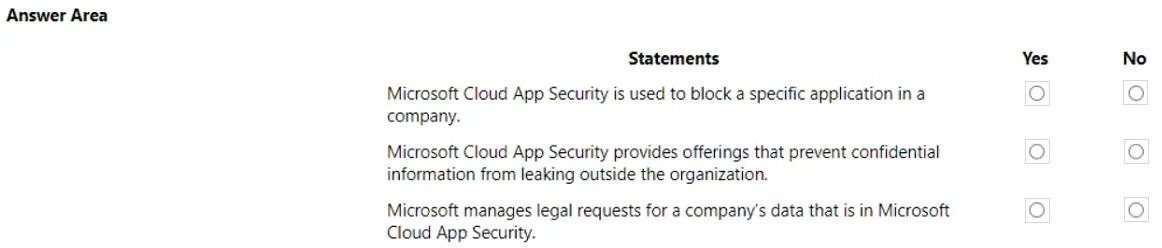
Answer Area
- Microsoft Cloud App Security is used to block a specific application in a company.Yes
- Microsoft Cloud App Security provides offerings that prevent confidential information from leaking outside the organization.Yes
- Microsoft manages legal requests for a company's data that is in Microsoft Cloud App Security.No
Explanation
All three statements accurately describe functionalities or responsibilities related to Microsoft Cloud App Security (now Microsoft Defender for Cloud Apps), encompassing application control, data loss prevention, and Microsoft's robust legal framework for managing data access requests.
Approach. For each statement, the correct interaction is to select 'Yes' as indicated by the second exhibit image. This requires understanding the core functionalities and operational model of Microsoft Cloud App Security (now Microsoft Defender for Cloud Apps - MDCA):
-
Statement 1: 'Microsoft Cloud App Security is used to block a specific application in a company.' This statement is True. MDCA functions as a Cloud Access Security Broker (CASB). It provides capabilities for discovering shadow IT, assessing risk, and controlling access to sanctioned and unsanctioned cloud applications. Policies can be configured to block access to specific applications, redirect users, or enforce granular controls, thus directly supporting the blocking of specific applications.
-
Statement 2: 'Microsoft Cloud App Security provides offerings that prevent confidential information from leaking outside the organization.' This statement is True. MDCA includes robust Data Loss Prevention (DLP) capabilities. It integrates with Microsoft Purview Information Protection (MPIP) to identify, classify, and protect sensitive data across various connected cloud applications. It can scan content at rest, apply real-time controls during uploads/downloads, and enforce policies to prevent the exfiltration of confidential information.
-
Statement 3: 'Microsoft manages legal requests for a company's data that is in Microsoft Cloud App Security.' This statement is True. While the customer owns their data, Microsoft, as the cloud service provider, has well-defined and legally compliant processes for handling government and law enforcement requests for customer data stored within its services. Microsoft's legal teams review, challenge, and respond to such requests in accordance with strict privacy principles and legal obligations, notifying customers whenever legally possible. In this sense, Microsoft actively 'manages' these requests directed at its infrastructure and services.
Common mistakes.
- common_mistake. A common mistake would be to select 'No' for any of these statements, which would indicate a misunderstanding of Microsoft Cloud App Security's comprehensive features and Microsoft's operational responsibilities within the cloud:
- Selecting 'No' for Statement 1 would disregard MDCA's fundamental CASB capabilities related to app governance, risk assessment, and enforcement of access and usage policies for cloud applications.
- Selecting 'No' for Statement 2 would overlook MDCA's critical role in data protection and its powerful DLP features, which are central to preventing sensitive information from leaving the organization via cloud apps.
- Selecting 'No' for Statement 3 would demonstrate an incomplete understanding of the shared responsibility model and Microsoft's robust legal framework. While customers retain ownership and control over their data, Microsoft, as the service provider, has established procedures and legal teams dedicated to managing external legal requests concerning the data stored and processed within its cloud services, including those data points relevant to MCAS/MDCA. They do not outsource this responsibility or act without defined processes.
Concept tested. The core concept being tested is a comprehensive understanding of Microsoft Cloud App Security (now Microsoft Defender for Cloud Apps) capabilities, including its role as a Cloud Access Security Broker (CASB), its Data Loss Prevention (DLP) functionalities, and Microsoft's responsibilities and legal processes concerning customer data within the Microsoft cloud ecosystem under the shared responsibility model.
Reference. https://learn.microsoft.com/en-us/defender-cloud-apps/what-is-defender-for-cloud-apps, https://learn.microsoft.com/en-us/azure/security/fundamentals/shared-responsibility
Topics
Community Discussion
No community discussion yet for this question.