
MS-102 · Question #55
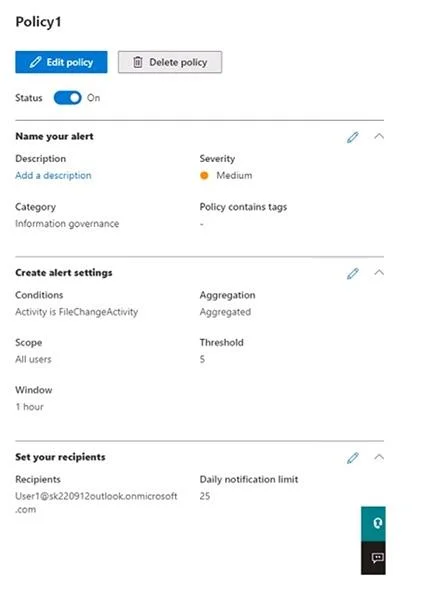
You have a Microsoft 365 tenant that contains two users named User1 and User2. You create the alert policy shown in the following exhibit. User2 runs a script that modifies a file in a Microsoft…
The correct answer is A. 2. User2 modifies a file every 4 minutes for 2 hours, generating 30 total modification events (120 minutes ÷ 4 minutes = 30 events). However, the alert policy shown uses an aggregation window (typically 60 minutes) to group multiple matching activities into a single alert…
Question
You have a Microsoft 365 tenant that contains two users named User1 and User2. You create the alert policy shown in the following exhibit. User2 runs a script that modifies a file in a Microsoft SharePoint library once every four minutes and runs for a period of two hours. How many alerts will User1 receive?
Exhibit
Options
- A2
- B5
- C10
- D25
- E30
How the community answered
(56 responses)- A77% (43)
- B2% (1)
- C11% (6)
- D7% (4)
- E4% (2)
Explanation
User2 modifies a file every 4 minutes for 2 hours, generating 30 total modification events (120 minutes ÷ 4 minutes = 30 events). However, the alert policy shown uses an aggregation window (typically 60 minutes) to group multiple matching activities into a single alert notification rather than firing one alert per event. With a 1-hour aggregation window, all events within the first hour are bundled into one alert, and all events within the second hour are bundled into a second alert. This produces exactly 2 alerts delivered to User1. This aggregation behavior is standard in Microsoft 365 alert policies to prevent alert fatigue from high-frequency events.
Topics
Community Discussion
No community discussion yet for this question.