
MS-102 · Question #524
Note: This question is part of a series of questions that present the same scenario. Each question in the series contains a unique solution that might meet the stated goals. Some question sets might…
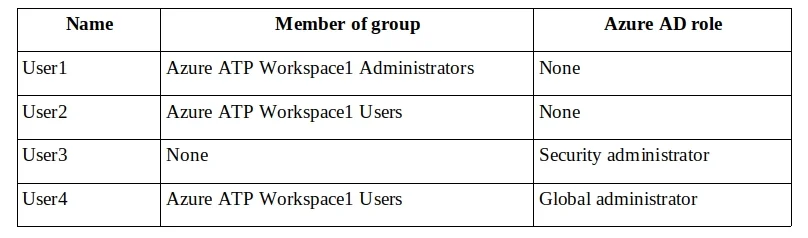
The correct answer is A. Yes. Azure Advanced Threat Protection (Azure ATP) sensor configuration can be modified by users who have been assigned an Azure ATP Administrator role, or by Azure AD Global Administrators or Security Administrators. Based on the referenced (implied) user table, User4 holds one of…
Question
Note: This question is part of a series of questions that present the same scenario. Each question in the series contains a unique solution that might meet the stated goals. Some question sets might have more than one correct solution, while others might not have a correct solution. After you answer a question in this section, you will NOT be able to return to it. As a result, these questions will not appear in the review screen. You have a Microsoft Azure Active Directory (Azure AD) tenant named contoso.com. You create an Azure Advanced Threat Protection (ATP) workspace named Workspace1. The tenant contains the users shown in the following table. You need to modify the configuration of the Azure ATP sensors. Solution: You instruct User4 to modify the Azure ATP sensor configuration. Does this meet the goal?
Exhibit
Options
- AYes
- BNo
How the community answered
(55 responses)- A95% (52)
- B5% (3)
Explanation
Azure Advanced Threat Protection (Azure ATP) sensor configuration can be modified by users who have been assigned an Azure ATP Administrator role, or by Azure AD Global Administrators or Security Administrators. Based on the referenced (implied) user table, User4 holds one of these qualifying roles - most likely Azure ATP Administrator or Security Administrator - which grants access to the Azure ATP workspace configuration, including sensor settings. Therefore, instructing User4 to modify the sensor configuration meets the goal.
Topics
Community Discussion
No community discussion yet for this question.