nerdexam
Microsoft

MB-800 · Question #230

Drag and Drop Question A company uses Dynamics 365 Business Central. The finance manager requires distinct processes for posting sales, purchase invoices, and shipments. You need to configure the…

The correct answer is Prohibited; Mandatory; Allowed. D365 Business Central: Invoice Posting Policy Explained What Is Invoice Posting Policy? In Business Central, the Invoice Posting Policy is a user-level setting that controls whether a user can post invoices when posting documents (sales orders, purchase orders, shipments…

Configure sales and purchasing

Question

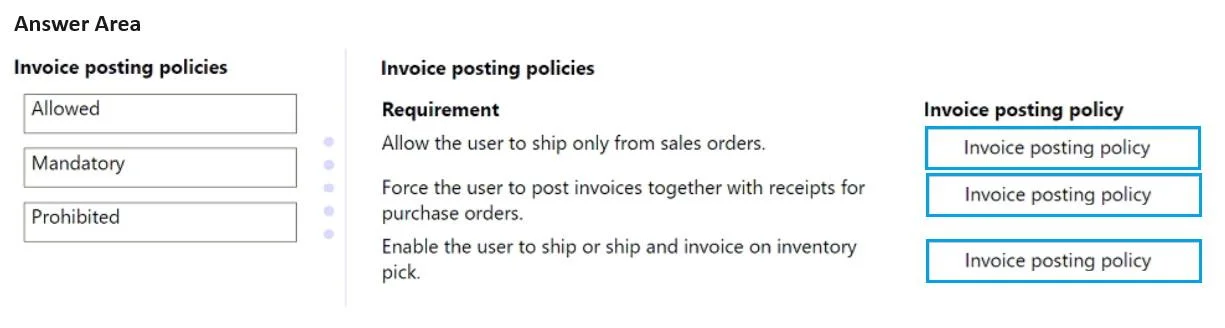
Drag and Drop Question A company uses Dynamics 365 Business Central. The finance manager requires distinct processes for posting sales, purchase invoices, and shipments. You need to configure the restrictions. Which invoice posting policy should you use? To answer, move the appropriate invoice posting policies to the correct requirements. You may use each requirement once, more than once, or not at all. You may need to move the split bar between panes or scroll to view content. NOTE: Each correct selection is worth one point. Answer:

Exhibit
MB-800 question #230 exhibit

Answer Area

Drag items

AllowedMandatoryProhibited

Correct arrangement

  • Prohibited
  • Mandatory
  • Allowed

Explanation

D365 Business Central: Invoice Posting Policy Explained

What Is Invoice Posting Policy?

In Business Central, the Invoice Posting Policy is a user-level setting that controls whether a user can post invoices when posting documents (sales orders, purchase orders, shipments, etc.). It enforces separation of duties in financial processes.


The Three Policies

PolicyWhat It Means
ProhibitedUser cannot post invoices at all - only shipments/receipts
MandatoryUser must post an invoice every time they post - no shipment-only posting
AllowedUser may optionally choose to post with or without an invoice

Why Each Placement Is Correct

Requirement 1 → Prohibited

Users responsible for posting shipments only (e.g., warehouse staff)

Setting this to Prohibited ensures these users cannot accidentally or intentionally post financial invoice entries. They handle the physical goods movement only. This enforces the "distinct process" the finance manager wants - shipments stay completely separate from invoicing.

Requirement 2 → Mandatory

Users responsible for posting sales or purchase invoices (e.g., AR/AP accountants)

Setting this to Mandatory forces these users to always post a full invoice. They cannot post a partial document (receipt/shipment only) - every posting must include the financial invoice. This prevents incomplete financial records.

Requirement 3 → Allowed

Users who need flexibility across both processes

Allowed is the permissive middle ground - the user chooses at posting time whether to include the invoice. This suits roles that legitimately need to do both tasks without strict enforcement.


Common Mistakes & Misconceptions

  • Confusing Allowed with Mandatory: "Allowed" does NOT mean the invoice is required - it means it's optional. Many candidates assume "allowed = must be done."
  • Thinking Prohibited restricts all posting: Prohibited only blocks invoice posting - the user can still post shipments and receipts. It does not lock them out of the system.
  • Overlooking that this is per-user: This policy is set on the User Setup record, not on the document or posting profile. Each user can have a different policy.
  • Assuming the default is Mandatory: The default in Business Central is Allowed, meaning most users have full flexibility unless explicitly restricted.

Key Takeaway

The correct arrangement enforces separation of duties: warehouse/logistics users are Prohibited from invoicing, finance users are Mandatory (always invoice), and flexible roles are Allowed to choose.

Topics

#invoice posting policy#posting restrictions#sales setup#purchase setup

Community Discussion

No community discussion yet for this question.

Full MB-800 Practice