
MB-330 · Question #389
Drag and Drop Question A company uses Dynamics 365 Supply Chain Management to sell automobile tires. The company sells different models of tires. Each model is available in different diameter sizes…
The correct answer is Released product master; Trade agreements. Dynamics 365 SCM - Tire Pricing Configuration The Two Requirements The scenario has two distinct pricing needs: | Requirement | Configuration | |---|---| | MSRP: static, never changes, must be the default selling price | Released product master | | Purchase prices: vary by…
Question
Exhibit
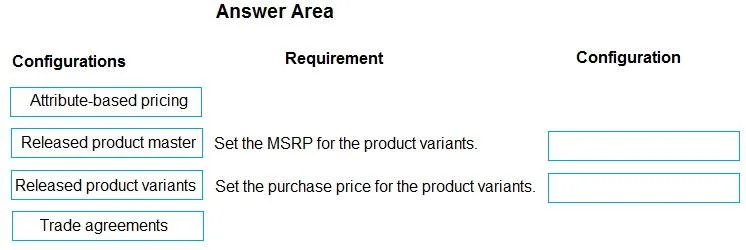
Answer Area
Drag items
Correct arrangement
- Released product master
- Trade agreements
Explanation
Dynamics 365 SCM - Tire Pricing Configuration
The Two Requirements
The scenario has two distinct pricing needs:
| Requirement | Configuration |
|---|---|
| MSRP: static, never changes, must be the default selling price | Released product master |
| Purchase prices: vary by variant, change over time, must be systematically documented | Trade agreements |
Placement 1: Released Product Master → MSRP
The released product master has a base sales price field. This is the fallback price the system uses when no trade agreement or special price applies - which matches the requirement that MSRP "must be the default selling price if no other pricing is available."
Setting it on the master (not the variant) also reflects that MSRP is the same across all diameter variants of a model and never changes after configuration. It's a one-time setup at the product level.
Placement 2: Trade Agreements → Purchase Prices
Trade agreements are D365's purpose-built tool for prices that:
- Are variant-specific (you can specify exact dimension combinations like model + size)
- Are date-effective (new price lines replace old ones as prices change over time)
- Are documented systematically via trade agreement journals, which provide an audit trail of every price change
This satisfies all three purchase price requirements simultaneously.
Why the Other Options Are Wrong
Released product variants - Variants are product records (the SKU entities), not a pricing configuration mechanism. A common mistake is selecting this because the question emphasizes variants, but you don't configure prices on variants directly.
Attribute-based pricing - This applies to configurable products using the Product Configurator (BOM-based, constraint-based models). Tires sold by model + size are dimension-based variants, not configurator outputs. Wrong tool.
Key Misconception to Avoid
"The purchase price varies by variant, so I should configure it on the released product variant."
Wrong. Variants hold product identity (dimensions), not prices. Trade agreements are what bind prices to specific variant combinations with time-effectivity and change history.
Topics
Community Discussion
No community discussion yet for this question.