
MB-310 · Question #185
Drag and Drop Question You are implementing Dynamics 365 Finance. A new product is being released. The system must track the probability of the new product by cost center and you must use the cost…
The correct answer is Statistical dimension; Cost element; Cost object. Dynamics 365 Finance - Cost Control Workspace Configuration > Note: The question likely says profitability (not "probability") - this is a known typo in some exam versions. --- Context In D365 Finance Cost Accounting, configuring the Cost Control Workspace requires three…
Question
Exhibit
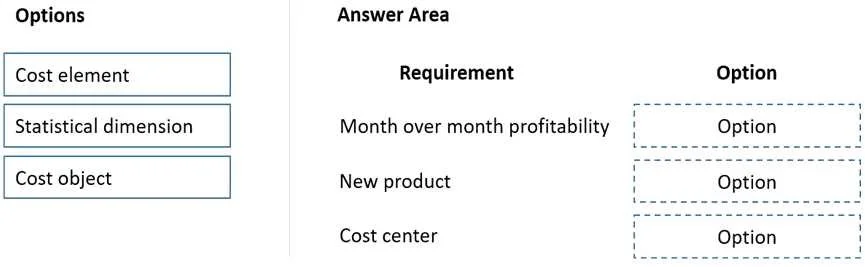
Answer Area
Drag items
Correct arrangement
- Statistical dimension
- Cost element
- Cost object
Explanation
Dynamics 365 Finance - Cost Control Workspace Configuration
Note: The question likely says profitability (not "probability") - this is a known typo in some exam versions.
Context
In D365 Finance Cost Accounting, configuring the Cost Control Workspace requires three distinct dimension types. The question maps three unnamed requirements to the correct configuration options.
Correct Arrangement Explained
Position 1 → Statistical Dimension
Purpose: Tracks non-monetary quantities (e.g., units produced, headcount, machine hours).
Why here: To track a new product's profitability, you need a statistical measure (e.g., units sold/produced) that can serve as an allocation base or analysis driver. Statistical dimensions capture this non-financial data that doesn't live in the general ledger.
Position 2 → Cost Element
Purpose: Classifies what kind of cost is being incurred (maps directly from GL accounts - materials, labor, overhead, etc.).
Why here: To track profitability, you must categorize the costs themselves. Cost elements define the nature of costs flowing into cost accounting. Without them, you cannot analyze what is being spent.
Position 3 → Cost Object
Purpose: Defines what the cost is attributed to - the "who" or "what" accumulates cost.
Why here: The requirement is to track by cost center. In D365 Cost Accounting, cost centers are configured as cost object dimensions - not as standalone "cost centers." The Cost Control Workspace surfaces costs aggregated against cost objects.
Common Mistakes
| Mistake | Why It's Wrong |
|---|---|
| Selecting "Cost center" directly | "Cost center" is an available item but is a distractor. In Cost Accounting, cost centers are represented through cost object dimensions, not as a separate configuration type. |
| Confusing cost element with cost object | Cost element = the nature of the cost (what). Cost object = the target of the cost (where/who). |
| Skipping statistical dimension | Many candidates overlook this - it's required to measure quantities/allocations for a new product that may not yet have full GL history. |
Summary
| Position | Answer | Role |
|---|---|---|
| 1 | Statistical dimension | Measures non-monetary product data |
| 2 | Cost element | Classifies cost types from GL |
| 3 | Cost object | Represents cost centers as cost targets |
Topics
Community Discussion
No community discussion yet for this question.