
LEAD-AUDITOR · Question #343
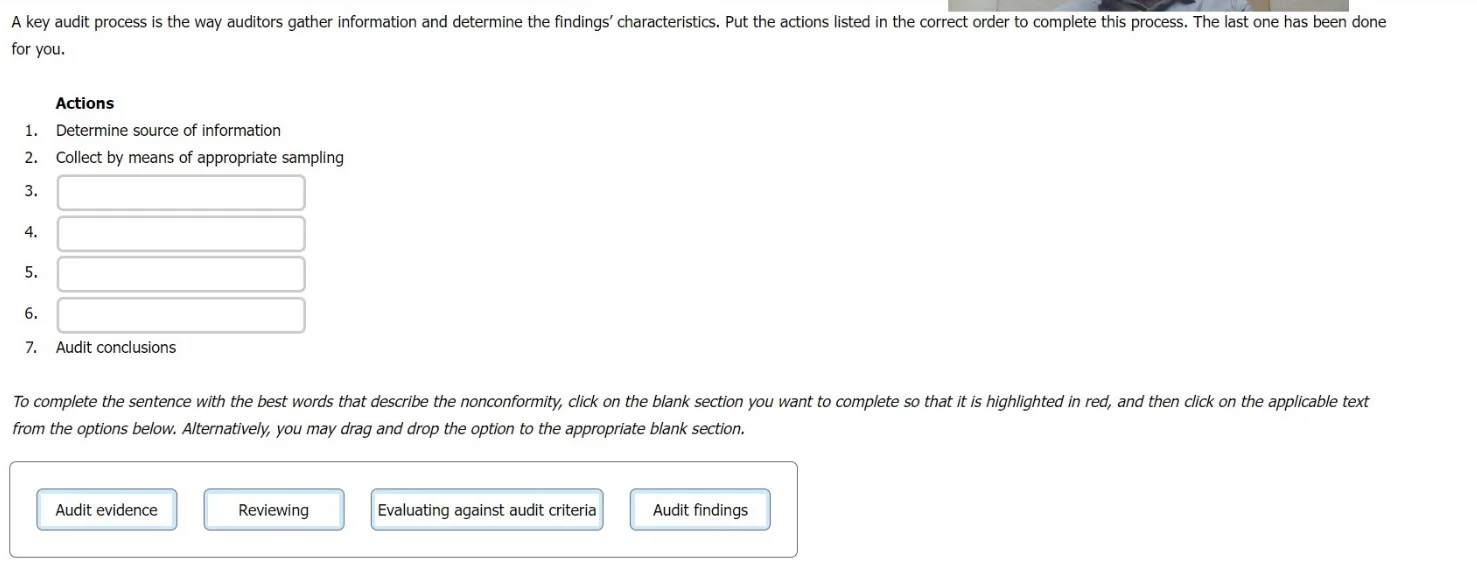
Drag and Drop Question A key audit process is the way auditors gather information and determine the findings' characteristics. Put the actions listed in the correct order to complete this process…
The correct answer is Reviewing; Audit evidence; Evaluating against audit criteria; Audit findings. Audit Process: Correct Order Explained The sequence describes the logical flow of how auditors gather information and arrive at conclusions. Think of it as a cause-and-effect chain where each step enables the next. --- The Correct Sequence 1. Reviewing This is the starting…
Question
Drag and Drop Question A key audit process is the way auditors gather information and determine the findings' characteristics. Put the actions listed in the correct order to complete this process. The last one has been done for you. Answer:
Exhibit
Answer Area
Drag items
Correct arrangement
- Reviewing
- Audit evidence
- Evaluating against audit criteria
- Audit findings
Explanation
Audit Process: Correct Order Explained
The sequence describes the logical flow of how auditors gather information and arrive at conclusions. Think of it as a cause-and-effect chain where each step enables the next.
The Correct Sequence
1. Reviewing
This is the starting action. Auditors begin by actively examining documents, records, processes, and activities. "Reviewing" is the physical/cognitive act that initiates information gathering - you cannot collect evidence without first looking at something. It must be first because all subsequent steps depend on it.
2. Audit Evidence
Reviewing produces audit evidence - the verifiable records, statements of fact, or other information relevant to the audit criteria. Evidence is the output of reviewing, not a standalone activity. It sits second because it is what you have after reviewing but before you can draw any conclusions.
Common mistake: Treating "audit evidence" as an action rather than a result. It is the material collected, not the act of collecting it.
3. Evaluating Against Audit Criteria
With evidence in hand, the auditor compares it against predefined standards, requirements, or benchmarks (e.g., ISO standards, regulations, internal policies). This step cannot come before evidence exists - you need something to evaluate. Evaluation is the analytical step that bridges raw data and conclusions.
Common mistake: Skipping directly from reviewing to findings. Without explicit evaluation against criteria, findings lack objective basis and defensibility.
4. Audit Findings
Findings are the result of evaluation - conclusions about conformity, nonconformity, or opportunities for improvement. They can only exist after evidence has been evaluated against criteria. This is correctly placed last because it is the culmination of the entire process, not an input to it.
The Chain in Plain Terms
You review → which yields evidence → which you evaluate against criteria → which produces findings.
Each step is the necessary precondition for the next, making this a strictly sequential process, not an interchangeable one.
Topics
Community Discussion
No community discussion yet for this question.