
LEAD-AUDITOR · Question #342
Drag and Drop Question In the context of a management system audit, please identify the sequence of a typical process of collecting and verifying information. The first one has been done for you…
The correct answer is Identifying the source of information; Gathering audit evidence; Sampling the available data; Verifying objective evidence; Evaluating evidence against the audit criteria; Recording audit findings; Placing audit conclusions. Audit Information Collection & Verification - Sequence Explained This sequence follows the logic of ISO 19011 (Guidelines for Auditing Management Systems). Each step builds on the previous; skipping or reordering steps undermines audit integrity. --- Step-by-Step Rationale 1…
Question
Drag and Drop Question In the context of a management system audit, please identify the sequence of a typical process of collecting and verifying information. The first one has been done for you. Answer:
Exhibit
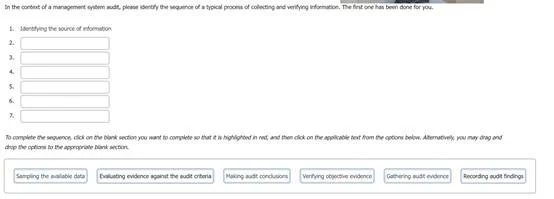
Answer Area
Drag items
Correct arrangement
- Identifying the source of information
- Gathering audit evidence
- Sampling the available data
- Verifying objective evidence
- Evaluating evidence against the audit criteria
- Recording audit findings
- Placing audit conclusions
Explanation
Audit Information Collection & Verification - Sequence Explained
This sequence follows the logic of ISO 19011 (Guidelines for Auditing Management Systems). Each step builds on the previous; skipping or reordering steps undermines audit integrity.
Step-by-Step Rationale
1. Identifying the source of information (given) Before collecting anything, you must know where valid information exists - documents, records, personnel, processes. Without a defined source, evidence gathering is arbitrary and uncontrolled. This is the planning foundation.
2. Gathering audit evidence Now that sources are identified, you collect raw evidence from them - interviews, document reviews, observations. You can't sample, verify, or evaluate what hasn't been gathered yet. This is an active collection phase.
3. Sampling the available data Not all gathered evidence can be reviewed in full. Sampling selects a representative subset for deeper analysis. Sampling comes after gathering because you need the full pool before you can intelligently select a sample from it.
4. Verifying objective evidence The sample must be verified as factual, accurate, and traceable - i.e., "objective." You confirm authenticity and reliability before drawing any conclusions. Evaluating unverified evidence would risk invalid findings.
5. Evaluating evidence against the audit criteria Only after verification do you compare evidence to the audit criteria (standards, requirements, policies). This is where conformity or nonconformity is determined. Evaluation requires verified evidence as input.
6. Recording audit findings Findings - conformities, nonconformities, observations - are formally documented after evaluation. You can only record what the evaluation has determined. This step creates the official audit trail.
7. Placing audit conclusions The overall conclusion (e.g., "the management system is effective / requires corrective action") is drawn from the totality of recorded findings. Conclusions always come last because they synthesize everything that preceded them.
Common Mistakes & Misconceptions
| Mistake | Why It's Wrong |
|---|---|
| Sampling before gathering | You can't sample a pool that hasn't been assembled yet |
| Evaluating before verifying | Evaluating unverified data produces unreliable findings |
| Recording findings after conclusions | Conclusions must be based on findings, not precede them |
| Confusing "findings" with "conclusions" | Findings are specific observations; conclusions are the overall audit judgment |
| Skipping verification entirely | Without it, subjective or falsified evidence could influence the outcome |
Memory Aid
Identify → Gather → Sample → Verify → Evaluate → Record → Conclude "I Got Some Very Excellent Results, Congratulations"
Topics
Community Discussion
No community discussion yet for this question.