
JN0-663 · Question #202
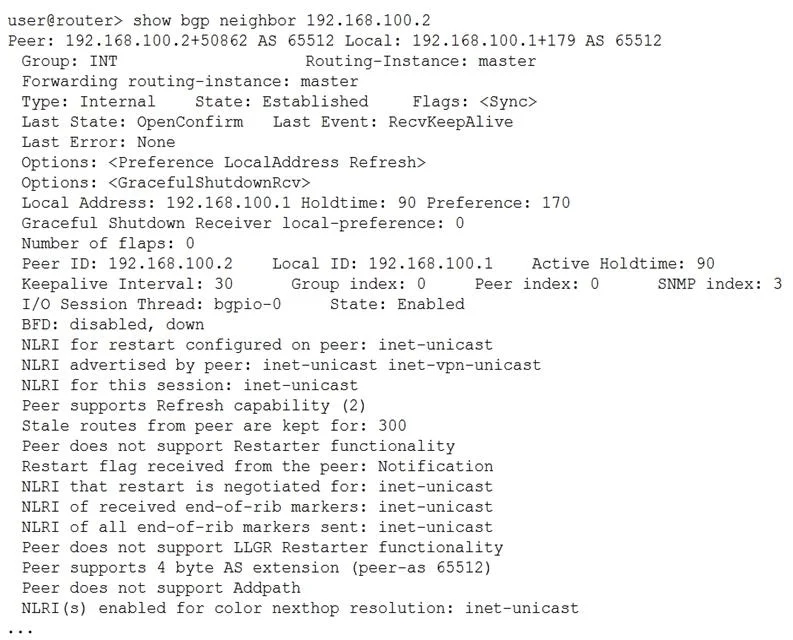
Exhibit: Referring to the exhibit, the local BGP router is receiving IPv4 routes from the BGP neighbor, but it is not receiving L3 VPN routes from the BGP neighbor. Which two actions should you take…
The correct answer is A. Configure the family inet-vpn unicast statement on the local BGP router. B. Configure the family inet unicast statement on the local BGP router. It is clearly shown in the exhibit that inet-unicast is the only NLRI enabled locally, so inet-vpn- unicast needs to be configured too. However, when you do this, it overrides the default NLRI for a peer which is inet-unicast, resulting in only inet-vpn-unicast being advertised…
Question
Exhibit:
Referring to the exhibit, the local BGP router is receiving IPv4 routes from the BGP neighbor, but it is not receiving L3 VPN routes from the BGP neighbor. Which two actions should you take to solve this problem? (Choose two.)
Exhibit
Options
- AConfigure the family inet-vpn unicast statement on the local BGP router.
- BConfigure the family inet unicast statement on the local BGP router.
- CConfigure the family inet unicast statement on the BGP neighbor
- DConfigure the family inet-vpn unicast statement on the BGP neighbor.
How the community answered
(44 responses)- A82% (36)
- C14% (6)
- D5% (2)
Explanation
It is clearly shown in the exhibit that inet-unicast is the only NLRI enabled locally, so inet-vpn- unicast needs to be configured too. However, when you do this, it overrides the default NLRI for a peer which is inet-unicast, resulting in only inet-vpn-unicast being advertised to the peer. To continue using inet-unicast this must now also be configured explicitly.
Topics
Community Discussion
No community discussion yet for this question.