nerdexam
Juniper

JN0-637 · Question #96

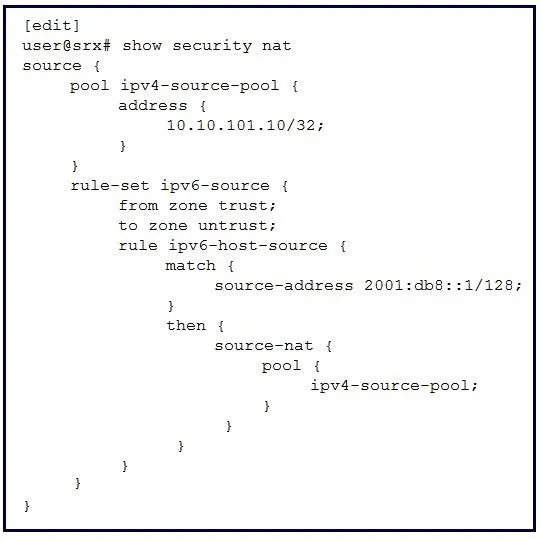
You are configuring NAT64 on your SRX Series device. You have committed the configuration shown in the exhibit. Unfortunately, the communication with the 10.10.201.10 server is not working. You have…

The correct answer is A. Configure source NAT to translate return traffic from IPv4 address to the IPv6 address of your. You're configuring NAT64 on a Juniper SRX device, as shown in the exhibit. Here's a summary of what you're doing: - You're translating IPv6 source traffic (2001:db8::1/128) going to an IPv4 destination (10.10.201.10/32). - You're using source NAT with the pool 10.10.101.10/32…

Complex NAT Deployments

Question

You are configuring NAT64 on your SRX Series device. You have committed the configuration shown in the exhibit. Unfortunately, the communication with the 10.10.201.10 server is not working. You have verified that the interfaces, security zones, and security policies are all correctly configured. In this scenario, which action will solve this issue?

Exhibit
JN0-637 question #96 exhibit

Options

  • AConfigure source NAT to translate return traffic from IPv4 address to the IPv6 address of your
  • BConfigure proxy-ARP on the external IPv4 interface for the 10.10.201.10/32 address.
  • CConfigure proxy-NDP on the IPv6 interface for the 2001:db8::1/128 address.
  • DConfigure destination NAT to translate return traffic from the IPv4 address to the IPv6 address of

How the community answered

(23 responses)
  • A
    57% (13)
  • B
    26% (6)
  • C
    13% (3)
  • D
    4% (1)

Explanation

You're configuring NAT64 on a Juniper SRX device, as shown in the exhibit. Here's a summary of what you're doing: - You're translating IPv6 source traffic (2001:db8::1/128) going to an IPv4 destination (10.10.201.10/32). - You're using source NAT with the pool 10.10.101.10/32. This configuration handles the outbound translation (IPv6 to IPv4), but communication is failing, and you've confirmed that: - Interfaces are up - Zones are correct - Security policies are correct In NAT64, when traffic flows from IPv6 to IPv4, the reverse path (IPv4 to IPv6) also needs to work. But IPv4-only devices can't initiate traffic to IPv6 hosts, nor do they understand how to return traffic unless it is translated back. This implies bi-directional NAT64 (also known as stateful NAT64) is needed. Without this, the return traffic from the IPv4 server will not be translated back to the original IPv6 address, and the session will fail.

Topics

#NAT64#IPv6#proxy-NDP#source NAT

Community Discussion

No community discussion yet for this question.

Full JN0-637 Practice