JN0-351 · Question #15
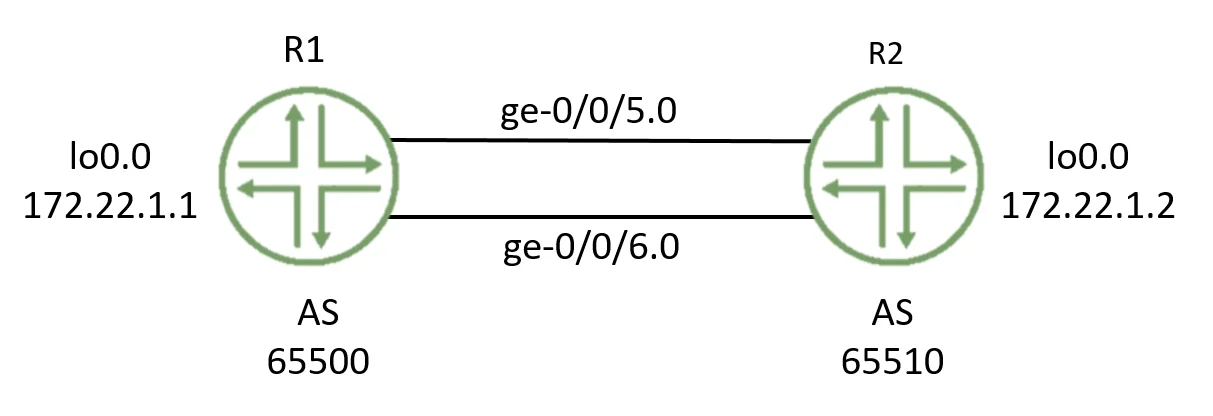
You want to enable redundancy for the EBGP peering between the two routers shown in the exhibit. Which three actions will you perform in this scenario? (Choose three.)
The correct answer is A. Configure BGP multihop. B. Configure loopback interface peering. C. Configure routes for the peer loopback interface IP addresses.. A is correct because you need to configure BGP multihop to enable redundancy for the EBGP peering between the two routers. BGP multihop is a feature that allows BGP peers to establish a session over multiple hops, instead of requiring them to be directly connected. By default, EB
Question
You want to enable redundancy for the EBGP peering between the two routers shown in the exhibit. Which three actions will you perform in this scenario? (Choose three.)
Exhibit
Options
- AConfigure BGP multihop.
- BConfigure loopback interface peering.
- CConfigure routes for the peer loopback interface IP addresses.
- DConfigure an MD5 peer authentication.
- EConfigure a cluster ID.
How the community answered
(28 responses)- A79% (22)
- D14% (4)
- E7% (2)
Explanation
A is correct because you need to configure BGP multihop to enable redundancy for the EBGP peering between the two routers. BGP multihop is a feature that allows BGP peers to establish a session over multiple hops, instead of requiring them to be directly connected. By default, EBGP peers use a time-to-live (TTL) value of 1 for their packets, which means that they can only reach adjacent neighbors. However, if you configure BGP multihop with a higher TTL value, you can allow EBGP peers to communicate over multiple routers in between. This can provide redundancy in case of a link failure or a router failure between the EBGP peers. B is correct because you need to configure loopback interface peering to enable redundancy for the EBGP peering between the two routers. Loopback interface peering is a technique that uses loopback interfaces as the source and destination addresses for BGP sessions, instead of physical interfaces. Loopback interfaces are virtual interfaces that are always up and reachable as long as the router is operational. By using loopback interface peering, you can avoid the dependency on a single physical interface or link for the BGP session, and use multiple paths to reach the loopback address of the peer. This can provide redundancy and load balancing for the C is correct because you need to configure routes for the peer loopback interface IP addresses to enable redundancy for the EBGP peering between the two routers. Routes for the peer loopback interface IP addresses are necessary to ensure that the routers can reach each other's loopback addresses over multiple hops. You can use static routes or dynamic routing protocols to advertise and learn the routes for the peer loopback interface IP addresses. Without these routes, the routers will not be able to establish or maintain the BGP session using their loopback interfaces.
Topics
Community Discussion
No community discussion yet for this question.
