nerdexam
Juniper

JN0-351 · Question #21

You are troubleshooting an issue where traffic to 192.168.10.0/24 is being sent to R1 instead of your desired path through R2. Referring to the exhibit, what is the reason for the problem?

The correct answer is C. R1's route is the best path due to a higher local preference. The exhibit shows the output of the command show ip bgp, which displays information about the BGP routes in the routing table. The output shows two routes for the destination 192.168.10.0/24, one from R1 and one from R2. The route from R1 has a local preference of 200, while…

BGP

Question

You are troubleshooting an issue where traffic to 192.168.10.0/24 is being sent to R1 instead of your desired path through R2. Referring to the exhibit, what is the reason for the problem?

Exhibit
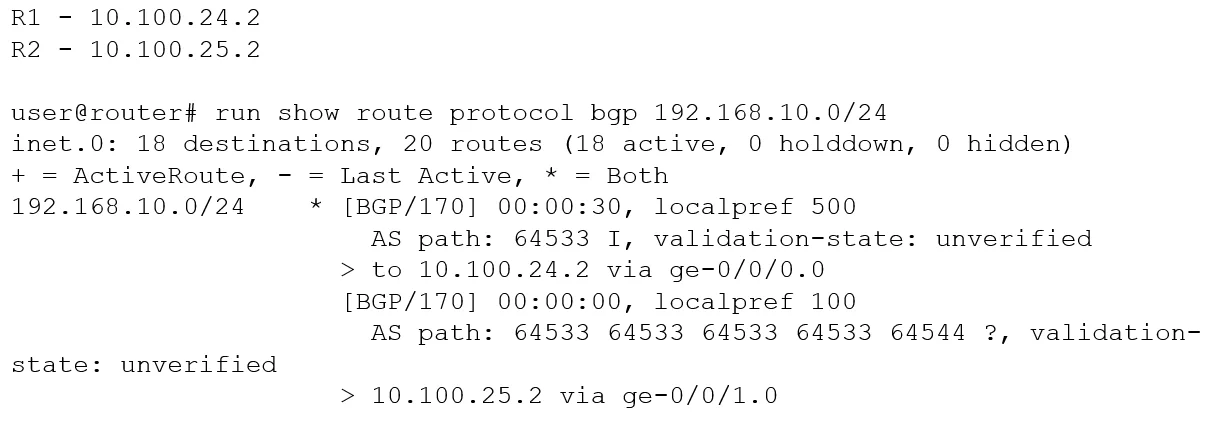
JN0-351 question #21 exhibit

Options

  • AR2's route is not the best path due to loop prevention.
  • BR2's route is not the best path due to a lower origin code.
  • CR1's route is the best path due to a higher local preference
  • DR1's route is the best path due to the shorter AS path.

How the community answered

(29 responses)
  • A
    7% (2)
  • B
    14% (4)
  • C
    76% (22)
  • D
    3% (1)

Explanation

The exhibit shows the output of the command show ip bgp, which displays information about the BGP routes in the routing table. The output shows two routes for the destination 192.168.10.0/24, one from R1 and one from R2. The route from R1 has a local preference of 200, while the route from R2 has a local preference of 100. Local preference is a BGP attribute that indicates the degree of preference for a route within an autonomous system (AS). A higher local preference means a more preferred route. BGP uses a best path selection algorithm to choose the best route for each destination among multiple paths. The algorithm compares different attributes of the routes in a specific order of precedence. The first attribute that is compared is weight, which is a Cisco-specific attribute that is local to the router. If the weight is equal or not set, the next attribute that is compared is local In this case, both routes have the same weight of 0, which means that they are learned from external BGP (eBGP) peers. Therefore, the next attribute that is compared is local preference. Since R1's route has a higher local preference than R2's route, it is chosen as the best path and installed in the routing table. The other attributes, such as origin code and AS path, are not considered in this case.

Topics

#BGP path selection#local preference#AS path#troubleshooting

Community Discussion

No community discussion yet for this question.

Full JN0-351 Practice