
ISO-IEC-27001-LEAD-AUDITOR · Question #144
Drag and Drop Question Please match the following situations to the type of audit required. Answer:
The correct answer is First-party audit; Second-party audit; Third-party audit; Combined audit. The question as shared is missing the situation descriptions - only the answer labels were included, not the scenarios to match them to. I'll explain each audit type thoroughly so you can apply them correctly to whatever scenarios appear on your exam. --- The Four Audit Types…
Question
Drag and Drop Question Please match the following situations to the type of audit required. Answer:
Exhibit
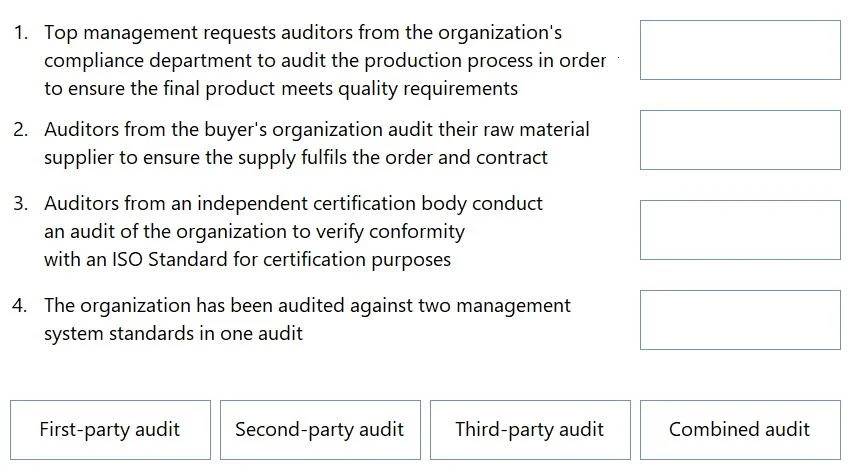
Answer Area
Drag items
Correct arrangement
- First-party audit
- Second-party audit
- Third-party audit
- Combined audit
Explanation
The question as shared is missing the situation descriptions - only the answer labels were included, not the scenarios to match them to. I'll explain each audit type thoroughly so you can apply them correctly to whatever scenarios appear on your exam.
The Four Audit Types
1. First-Party Audit (Internal Audit)
Who conducts it: The organization audits itself.
- An internal team reviews the organization's own processes, systems, or procedures.
- Purpose: self-assessment, identifying improvement opportunities, preparing for external audits.
- Example scenario: "A company's QA department reviews its own production processes against ISO 9001 requirements."
2. Second-Party Audit
Who conducts it: An organization audits another party it has a direct relationship with (usually customer → supplier).
- Driven by contractual or commercial interest.
- Example scenario: "An automotive manufacturer audits one of its component suppliers to verify quality compliance before awarding a contract."
3. Third-Party Audit
Who conducts it: An independent external body with no commercial relationship to the auditee.
- Used for formal certification (ISO), regulatory compliance, or legal requirements.
- The auditor must be impartial.
- Example scenario: "An accredited certification body audits a company to grant ISO 9001 certification."
4. Combined Audit
What it is: Auditing two or more management systems simultaneously in a single audit event.
- Not a separate "party" - it describes the scope, not who is auditing.
- Efficient: saves time vs. running separate audits.
- Example scenario: "An auditor audits a company's ISO 9001 (quality) and ISO 14001 (environmental) systems in one visit."
- Don't confuse with a joint audit - a joint audit is when two auditing organizations audit the same auditee together.
Common Misconceptions
| Mistake | Clarification |
|---|---|
| Thinking second-party = external = third-party | Second-party has a direct relationship (contractual); third-party is truly independent |
| Treating "combined" as a party type | Combined refers to scope (multiple systems), not who is auditing |
| Assuming first-party audits are less rigorous | They can be thorough; they're just internally managed |
If you share the actual situation descriptions from the question, I can explain exactly why each one maps to its specific audit type.
Topics
Community Discussion
No community discussion yet for this question.