
ISO-IEC-27001-LEAD-AUDITOR · Question #128
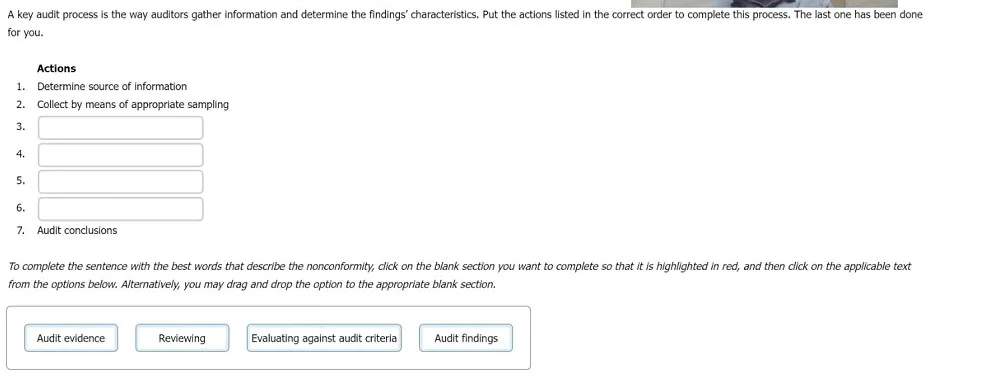
Drag and Drop Question A key audit process is the way auditors gather information and determine the findings' characteristics. Put the actions listed in the correct order to complete this process…
The correct answer is Recalculating; Audit evidence; Evaluating audit criteria; Audit findings. Audit Process: Order Explanation The Core Logic This sequence represents the evidence lifecycle in an audit: you perform a procedure → gather evidence → compare it to standards → reach a conclusion. --- Item-by-Item Breakdown 1. Recalculating (Position 1) Why first…
Question
Drag and Drop Question A key audit process is the way auditors gather information and determine the findings' characteristics. Put the actions listed in the correct order to complete this process. The last one has been done for you. Answer:
Exhibit
Answer Area
Drag items
Correct arrangement
- Recalculating
- Audit evidence
- Evaluating audit criteria
- Audit findings
Explanation
Audit Process: Order Explanation
The Core Logic
This sequence represents the evidence lifecycle in an audit: you perform a procedure → gather evidence → compare it to standards → reach a conclusion.
Item-by-Item Breakdown
1. Recalculating (Position 1)
Why first: Recalculating is an audit procedure - the active technique used to gather raw data. Before you can have evidence, you must do something (inspect, observe, recalculate, reperform). Recalculating a client's figures is the starting action that initiates the information-gathering process.
Common mistake: Treating recalculating as a later verification step. It is the initial data-collection action, not a check performed after findings are formed.
2. Audit Evidence (Position 2)
Why second: Audit evidence is the output of the procedure. When you recalculate and find that figures agree (or don't), that result becomes your evidence - verifiable information relevant to the audit objectives. You cannot have evidence without first performing a procedure.
Common mistake: Confusing evidence with findings. Evidence is raw, factual data; findings are the interpreted conclusion drawn from that data.
3. Evaluating Audit Criteria (Position 3)
Why third: Audit criteria are the benchmarks or standards (policies, regulations, standards) against which you compare your evidence. You can only perform this comparison after you have evidence in hand. This step answers: "Does what I found meet the standard?"
Common mistake: Placing criteria evaluation first, as if criteria are established during gathering. Criteria exist beforehand, but the evaluation (comparing evidence to criteria) logically requires evidence first.
4. Audit Findings (Position 4 - pre-completed)
Why last: Findings are the conclusions produced by comparing evidence against criteria. A finding states the degree of conformance or non-conformance. Nothing can be "found" until all prior steps are complete.
Common mistake: Merging findings with evidence. Findings require judgment and comparison; evidence alone is just data.
Summary Flow
Recalculating → Audit Evidence → Evaluating Audit Criteria → Audit Findings
   (do it)        (what you got)      (compare to standard)     (conclusion)
Each step is a prerequisite for the next - the order is non-negotiable because each item is the input to the following step.
Topics
Community Discussion
No community discussion yet for this question.