
ISO-IEC-27001-LEAD-AUDITOR · Question #125
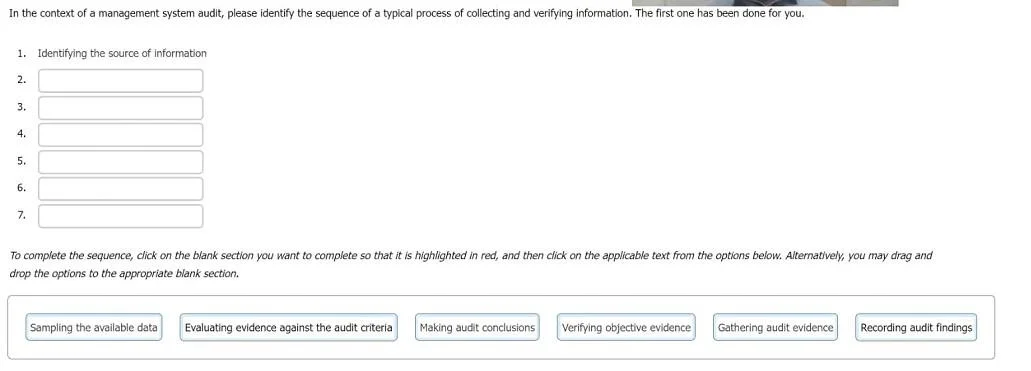
Drag and Drop Question In the context of a management system audit, please identify the sequence of a typical process of collecting and verifying information. The first one has been done for you…
The correct answer is Identifying the source of information; Gathering audit evidence; Sampling the available data; Verifying objective evidence; Evaluating evidence against the audit criteria; Recording audit findings; Making audit conclusions. Audit Information Collection & Verification Sequence This question is based on ISO 19011 (Guidelines for Auditing Management Systems) audit methodology. The sequence follows a logical funnel: from finding raw information → confirming it → judging it → documenting it →…
Question
Drag and Drop Question In the context of a management system audit, please identify the sequence of a typical process of collecting and verifying information. The first one has been done for you. Answer:
Exhibit
Answer Area
Drag items
Correct arrangement
- Identifying the source of information
- Gathering audit evidence
- Sampling the available data
- Verifying objective evidence
- Evaluating evidence against the audit criteria
- Recording audit findings
- Making audit conclusions
Explanation
Audit Information Collection & Verification Sequence
This question is based on ISO 19011 (Guidelines for Auditing Management Systems) audit methodology. The sequence follows a logical funnel: from finding raw information → confirming it → judging it → documenting it → concluding from it.
Step-by-Step Breakdown
1. Identifying the Source of Information (given)
Why first: Before you can collect anything, you must know where to look - documents, records, interviews, observations. This scopes the entire evidence-gathering effort. Skipping this leads to incomplete or irrelevant evidence.
2. Gathering Audit Evidence
Why here: Once sources are identified, you physically collect the raw evidence - documents, records, statements, data outputs. This is broad and unfiltered collection. You can't sample or verify what you haven't gathered yet.
Common mistake: Confusing "gathering" with "verifying." Gathering is acquisition; verification comes later.
3. Sampling the Available Data
Why here: Auditors rarely examine 100% of data - it's impractical. After gathering, you select a representative sample to work with. Sampling must happen before verification because you only verify what you've selected to examine.
Common mistake: Placing sampling before gathering. You cannot sample data you haven't collected yet.
4. Verifying Objective Evidence
Why here: Now you confirm that the sampled evidence is accurate, authentic, and factual - not opinion or hearsay. Verification is a quality check on the evidence itself (does this record actually say what it appears to say? Is it current?).
Common mistake: Skipping this step and going straight to evaluation. Unverified evidence leads to unreliable findings.
5. Evaluating Evidence Against Audit Criteria
Why here: Only after evidence is verified as reliable can you compare it against the standard/requirement (e.g., ISO 9001 clause, internal procedure). This is where you determine conformity or nonconformity.
Common mistake: Evaluating before verifying. Evaluation using unverified evidence is methodologically unsound and can produce invalid audit findings.
6. Recording Audit Findings
Why here: After evaluation produces a judgment (conformance, nonconformance, observation), it must be formally documented. Findings are the written output of evaluation - they cannot exist before evaluation is complete.
Common mistake: Recording findings and making conclusions simultaneously. Findings are the documented facts; conclusions are drawn from those findings - they are distinct steps.
7. Making Audit Conclusions
Why last: Conclusions are the auditor's overall judgment about the audit scope - synthesizing all findings to determine whether the management system meets its objectives. This requires all findings to be recorded first so the full picture is available.
Common mistake: Treating "findings" and "conclusions" as the same thing. Findings are specific (e.g., "Procedure X was not followed in 3 of 10 cases"). Conclusions are holistic (e.g., "The system demonstrates partial conformance with Clause 8").
Memory Aid
Think of it as a funnel:
Find → Collect → Select → Confirm → Judge → Document → Summarize
Each step depends entirely on the completion of the previous one - the sequence is not interchangeable.
Topics
Community Discussion
No community discussion yet for this question.