
HPE7-A08 · Question #98
Refer to the exhibits. What is the effect when you add the statement neighbor 10.2.0.3 send-community both to the IPv4 address family? (Select two)
The correct answer is B. It causes R1 to allow the exchange of communities with NLRI records in both inbound and D. It causes R1 to negotiate the ability to send and receive standard and extended communities with. Adding neighbor 10.2.0.3 send-community both enables R1 to send both standard (32-bit) and extended (64-bit) BGP community attributes alongside NLRI prefix updates to that neighbor - making B correct because communities travel with NLRI records, and D correct because the both…
Question
Refer to the exhibits. What is the effect when you add the statement neighbor 10.2.0.3 send-community both to the IPv4 address family? (Select two)
Exhibit
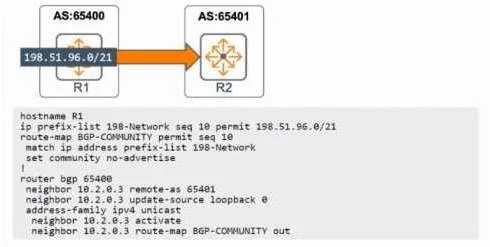
Options
- AIt causes R1 to negotiate for the ability to import and export all type-1 and type-2 communities
- BIt causes R1 to allow the exchange of communities with NLRI records in both inbound and
- CIt will cause the existing BGP peering between R1 and R2 to bounce
- DIt causes R1 to negotiate the ability to send and receive standard and extended communities with
How the community answered
(29 responses)- A24% (7)
- B66% (19)
- C10% (3)
Explanation
Adding neighbor 10.2.0.3 send-community both enables R1 to send both standard (32-bit) and extended (64-bit) BGP community attributes alongside NLRI prefix updates to that neighbor - making B correct because communities travel with NLRI records, and D correct because the both keyword explicitly covers both community types (standard for policy tagging, extended for VPN route-targets and route-origins).
A is wrong because "type-1 and type-2 communities" is fabricated terminology, and the phrasing about "import/export" belongs to MPLS VPN route-target logic - not the send-community command, which simply controls whether community attributes are attached to outbound UPDATE messages.
C is wrong because send-community is a local outbound advertisement policy change and does not trigger a BGP session reset; only commands that alter session parameters (such as update-source, ebgp-multihop, or changing the AS number) bounce the peering.
Memory tip: The keyword both maps directly to the two answer choices - think Both communities = B and D (standard + extended). If you remember that BGP never sends communities by default and requires explicit permission, you'll quickly eliminate any answer implying negotiation of "import/export" (a VPN concept) or a session bounce.
Topics
Community Discussion
No community discussion yet for this question.