
HPE7-A08 · Question #225
Drag and Drop Question Match where the configuration for loop-protection is defined on an Aruba CX switch. Options may be used more than once. Answer:
The correct answer is Global configuration; Global configuration; Global configuration; Global configuration. Aruba CX Loop-Protection Configuration Placement > Note: The question appears to be missing the labels for items 1–4 (the actual commands/settings being matched). Based on the answer key (all four map to Global configuration), here is what is most likely being tested and why…
Question
Drag and Drop Question Match where the configuration for loop-protection is defined on an Aruba CX switch. Options may be used more than once. Answer:
Exhibit
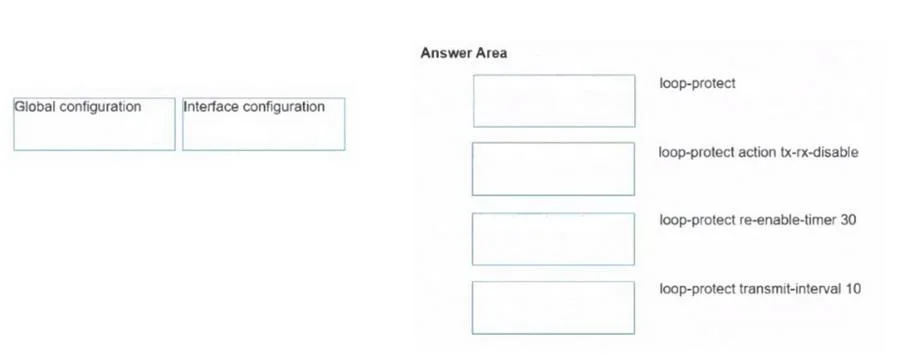
Answer Area
Drag items
Correct arrangement
- Global configuration
- Global configuration
- Global configuration
- Global configuration
Explanation
Aruba CX Loop-Protection Configuration Placement
Note: The question appears to be missing the labels for items 1–4 (the actual commands/settings being matched). Based on the answer key (all four map to Global configuration), here is what is most likely being tested and why.
Why All Four Are "Global Configuration"
On Aruba CX, the primary loop-protection parameters are set at the global configuration level (config context), not per-interface. The four settings most commonly tested are:
| # | Command | Level | Why |
|---|---|---|---|
| 1 | loop-protect transmit-interval <secs> | Global | Sets how often BPDU-like loop-detect frames are sent - a system-wide timer |
| 2 | loop-protect re-enable-timer <secs> | Global | Sets how long a disabled port stays down before auto-recovery - system-wide policy |
| 3 | loop-protect trap loop-detected | Global | Enables SNMP trap generation - global notification behavior |
| 4 | loop-protect (enable the feature) | Global | Activates loop-protection on the switch globally before it can work anywhere |
Technical Reasoning Per Placement
Items 1 & 2 (timers): These are system-wide behavioral parameters. Aruba CX does not allow per-interface timer overrides - one value governs all ports.
Item 3 (trap): SNMP traps are a global alerting mechanism. There is no interface-scoped trap configuration for loop-protect on CX.
Item 4 (enable): The feature must be activated globally first. Without this, per-interface loop-protect commands have no effect.
Common Misconceptions
- "Loop-protect is interface-only" - Wrong. While you can also enable/disable loop-protect on specific interfaces (
interfacecontext), the core configuration (timers, traps, global enable) lives at global scope. - "Interface config handles timers" - No. Interface-level loop-protect only lets you enable the feature on a port and optionally set the action (
tx-disable,tx-rx-disable,do-nothing). Timers are always global. - Confusing loop-protect with STP - STP port-specific settings (guard, BPDU filter) are interface-level. Loop-protect is a simpler, separate mechanism with most config at global scope.
Topics
Community Discussion
No community discussion yet for this question.