
HPE7-A08 · Question #122
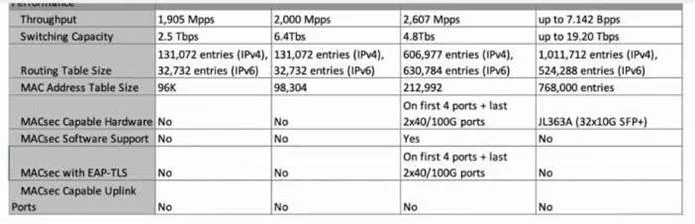
Refer to the exhibit. The ACME company has CX 8320 switches at the Services-Aggregation layer and CX 6200 switches at the Wired Access Layer. Wi-Fi WLANs are deployed in an L2 model. After…
The correct answer is B. Replace the CX 8320 with CX 8360 switches. Replacing the CX 8320 with CX 8360 switches resolves the issue because the CX 8360 uses a more capable ASIC with significantly larger hardware tables for IPv6 Neighbor Discovery (ND) entries, MLD snooping, and multicast groups - all of which explode in volume when IPv6 is…
Question
Refer to the exhibit. The ACME company has CX 8320 switches at the Services-Aggregation layer and CX 6200 switches at the Wired Access Layer. Wi-Fi WLANs are deployed in an L2 model. After implementing IPv6 for wireless clients alongside IPv4, connectivity problems have increased. What is the most efficient step to resolve this problem?
Exhibit
Options
- AChange the CX 8320 profile from L3-Agg to L3-Core
- BReplace the CX 8320 with CX 8360 switches
- CMigrate to the GW supercluster with two service aggregation layers
- DReplace the CX 8320 with CX 8325 switches
How the community answered
(25 responses)- A8% (2)
- B60% (15)
- C24% (6)
- D8% (2)
Explanation
Replacing the CX 8320 with CX 8360 switches resolves the issue because the CX 8360 uses a more capable ASIC with significantly larger hardware tables for IPv6 Neighbor Discovery (ND) entries, MLD snooping, and multicast groups - all of which explode in volume when IPv6 is introduced in an L2 wireless deployment. The CX 8320's hardware limits become a bottleneck at the aggregation layer precisely when dual-stack L2 environments flood ND and RA traffic upward.
Why the distractors are wrong:
- A (Change profile to L3-Core): A software profile change doesn't expand the hardware ASIC's table capacity - the physical limitation remains.
- C (GW supercluster with two aggregation layers): This adds architectural complexity and cost without addressing the root cause of the CX 8320's IPv6 hardware constraint.
- D (Replace with CX 8325): The CX 8325 is still in the 8300 series and shares the same underlying ASIC family as the 8320, so it carries the same IPv6 scaling limitations.
Memory tip: Think "360 = full circle IPv6 support." When IPv6 pushes L2 aggregation past its limits, you need the 8360's expanded ASIC capacity - same rack slot, same vendor, bigger tables.
Topics
Community Discussion
No community discussion yet for this question.