
HPE7-A08 · Question #109
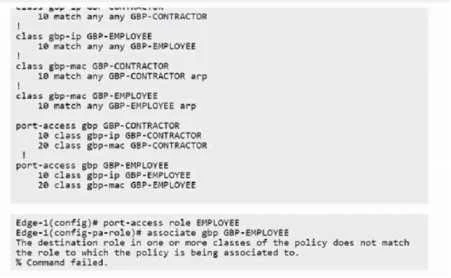
Refer to the exhibit. Based on the output above, what is required to associate the GBP policy with a user role?
The correct answer is D. Update the entries in the class maps to reference the EMPLOYEE role. In Aruba's Group-Based Policy framework, GBP policies are enforced through class maps that define which traffic matches which policy. Class maps must explicitly reference the user role by name (e.g., EMPLOYEE) to create the binding - without this reference, the switch has no…
Question
Refer to the exhibit. Based on the output above, what is required to associate the GBP policy with a user role?
Exhibit
Options
- AConfigure a user role called GBP-EMPLOYEE instead of EMPLOYEE
- BAssociate the port-access role to the GBP role using the role ID
- CUpdate the port-access GBP policies to reference the EMPLOYEE role
- DUpdate the entries in the class maps to reference the EMPLOYEE role
How the community answered
(47 responses)- A6% (3)
- B11% (5)
- C26% (12)
- D57% (27)
Explanation
In Aruba's Group-Based Policy framework, GBP policies are enforced through class maps that define which traffic matches which policy. Class maps must explicitly reference the user role by name (e.g., EMPLOYEE) to create the binding - without this reference, the switch has no way to know which role triggers which policy, so updating the class map entries is the required step.
Why the distractors fail:
- A is wrong because GBP doesn't require a special naming convention on the role itself - the role name "EMPLOYEE" is perfectly valid as-is.
- B is wrong because while role IDs exist in GBP contexts, the association mechanism here is through class maps, not a direct port-access-to-GBP-role ID mapping.
- C is wrong because it inverts the relationship - you don't update the GBP policy to reference the role; you update the class maps (which classify traffic) to reference the role, then the policy acts on that classification.
Memory tip: Think of class maps as the "address book" - they translate who you are (your role) into what traffic category you belong to. If the address book doesn't have your name (EMPLOYEE) listed, the policy never gets applied to you, no matter how well the policy itself is configured.
Topics
Community Discussion
No community discussion yet for this question.