
HPE7-A01 · Question #75
Drag and Drop Question Match the terms below to their characteristics (Options may be used more than once or not at all.) Answer:
The correct answer is Unicast: A device with IP address 10.1.3.7 in a network wants to send the traffic stream to a device with IP address 10.13.4.2 in the other network; Multicast: One/more senders and one/more recipients participate in data transfer traffic; IP Directed Broadcast: Sent to all hosts on a remote network; Broadcast: Sent to all NICs on the same network segment as the source NIC. Network Transmission Types - Exam Explanation --- The Four Transmission Types 1. Unicast → "A device with IP 10.1.3.7 wants to send traffic to 10.13.4.2 in another network" Unicast is one-to-one communication: a single sender targeting a single specific destination IP address…
Question
Drag and Drop Question Match the terms below to their characteristics (Options may be used more than once or not at all.) Answer:
Exhibit
Answer Area
Drag items
Correct arrangement
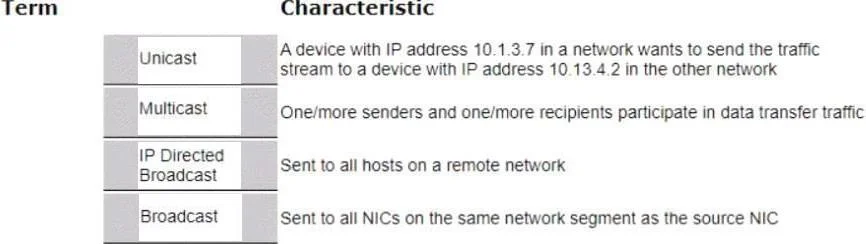
- Unicast: A device with IP address 10.1.3.7 in a network wants to send the traffic stream to a device with IP address 10.13.4.2 in the other network
- Multicast: One/more senders and one/more recipients participate in data transfer traffic
- IP Directed Broadcast: Sent to all hosts on a remote network
- Broadcast: Sent to all NICs on the same network segment as the source NIC
Explanation
Network Transmission Types - Exam Explanation
The Four Transmission Types
1. Unicast → "A device with IP 10.1.3.7 wants to send traffic to 10.13.4.2 in another network"
Unicast is one-to-one communication: a single sender targeting a single specific destination IP address. The key signals here are:
- Two distinct, specific IP addresses are named
- They are on different networks (10.1.3.x vs 10.13.4.x), which is fine - unicast crosses routers
- The traffic goes only to that one device, no one else receives it
Common mistake: Thinking unicast only works within the same network. Unicast is routable and works across networks - that's actually the norm for internet traffic.
2. Multicast → "One/more senders and one/more recipients participate in data transfer"
Multicast is one-to-many (selective) communication. The defining characteristic is that recipients opt in to a multicast group (e.g., 224.x.x.x range). Only subscribed devices receive the traffic - not everyone on the network.
The phrase "one/more senders and one/more recipients" is the textbook definition of multicast's flexibility. Examples: video streaming, routing protocol updates (OSPF uses 224.0.0.5).
Common mistake: Confusing multicast with broadcast. Broadcast hits everyone; multicast hits only interested/subscribed devices.
3. IP Directed Broadcast → "Sent to all hosts on a remote network"
An IP Directed Broadcast targets the broadcast address of a specific remote subnet (e.g., sending to 192.168.10.255 from a different network). A router must forward it to the destination network, where it then broadcasts to all hosts on that remote segment.
The word "remote" is the critical differentiator here. Directed broadcasts are routed across networks before being broadcast locally.
Common mistake: Mixing this up with a regular broadcast. Regular broadcast is local/same-segment only. IP Directed Broadcast is explicitly designed to reach a remote network's broadcast domain. Note: disabled by default on most modern routers (RFC 2644) due to Smurf attack risk.
4. Broadcast → "Sent to all NICs on the same network segment as the source NIC"
A standard broadcast (destination 255.255.255.255 or the subnet's broadcast address) is local only - it reaches every device on the same network segment. Routers do not forward broadcasts, which is why this is constrained to "same network segment."
The phrase "same network segment as the source NIC" is the defining constraint.
Common mistake: Thinking broadcasts cross routers. They don't - this is precisely why IP Directed Broadcast exists as a separate mechanism.
Quick Reference
| Type | Scope | Recipients | Routable? |
|---|---|---|---|
| Unicast | Any | 1 specific device | Yes |
| Multicast | Any | Subscribed group | Yes |
| IP Directed Broadcast | Remote network | All on remote segment | Yes (then local broadcast) |
| Broadcast | Local segment | All on local segment | No |
The core mental model: Unicast = one, Multicast = subscribed many, Broadcast = all local, IP Directed Broadcast = all remote.
Topics
Community Discussion
No community discussion yet for this question.