
HPE7-A01 · Question #118
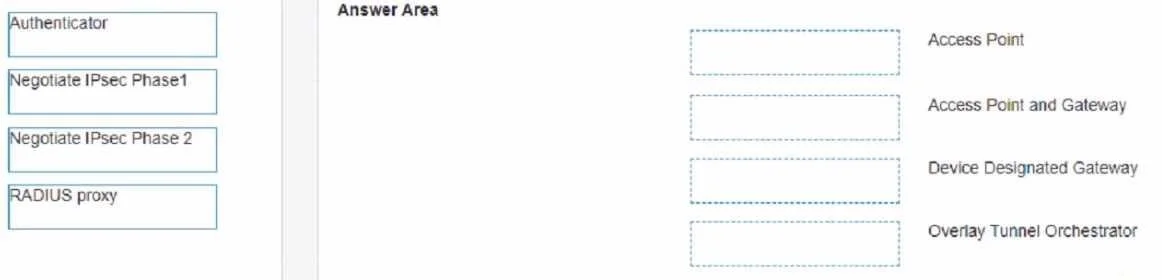
Drag and Drop Question Match the topics of an AOS10 Tunneled mode setup between an AP and a Gateway. (Options may be used more than once or not at all.) Answer:
The correct answer is Authenticator; Negotiate IPsec Phase 2; RADIUS proxy; Negotiate IPsec Phase 1. AOS10 Tunneled Mode: AP-to-Gateway Setup Explained Overview This is a matching exercise, not a sequential ordering. Each numbered position on the left corresponds to a specific role or step in the AOS10 Tunneled mode setup. You're dragging the correct concept to the correct…
Question
Drag and Drop Question Match the topics of an AOS10 Tunneled mode setup between an AP and a Gateway. (Options may be used more than once or not at all.) Answer:
Exhibit
Answer Area
Drag items
Correct arrangement
- Authenticator
- Negotiate IPsec Phase 2
- RADIUS proxy
- Negotiate IPsec Phase 1
Explanation
AOS10 Tunneled Mode: AP-to-Gateway Setup Explained
Overview
This is a matching exercise, not a sequential ordering. Each numbered position on the left corresponds to a specific role or step in the AOS10 Tunneled mode setup. You're dragging the correct concept to the correct descriptor. The "odd" ordering (Phase 2 before Phase 1) is the #1 source of confusion - more on that below.
In AOS10 Tunneled mode, an AP establishes a secure IPsec tunnel to an Aruba Gateway and forwards all client traffic through it. Two distinct processes happen: tunnel establishment (IPsec) and client authentication (802.1X + RADIUS).
Item-by-Item Breakdown
Position 1 → Authenticator
The AP acts as the 802.1X Authenticator for wireless clients.
In 802.1X, the Authenticator is the device that:
- Intercepts client traffic until authentication completes
- Relays EAP messages between the client (Supplicant) and the RADIUS server
- Enforces access (allow/deny) based on the RADIUS response
In tunneled mode, the AP takes this role directly - it doesn't offload authentication initiation to the Gateway. The AP is the enforcement point.
Position 2 → Negotiate IPsec Phase 2
IPsec Phase 2 (IKE Phase 2 / Quick Mode) establishes the actual IPsec Security Associations (SAs) used to encrypt and protect the data tunnel between the AP and Gateway.
This negotiates:
- Encryption algorithm for the data plane (e.g., AES-256)
- Integrity/hashing (e.g., SHA-256)
- Lifetime of the data SA
This is the tunnel that client traffic flows through.
Position 3 → RADIUS proxy
The Gateway acts as a RADIUS proxy.
Once the AP has authenticated a client via 802.1X, the RADIUS request is forwarded through the IPsec tunnel to the Gateway. The Gateway:
- Receives the RADIUS Access-Request from the AP
- Proxies it to the corporate RADIUS server (e.g., ClearPass)
- Returns the RADIUS response back to the AP
This keeps the AP simple - it doesn't need a direct route to the RADIUS server.
Position 4 → Negotiate IPsec Phase 1
IPsec Phase 1 (IKE Phase 1 / Main Mode or Aggressive Mode) establishes the IKE Security Association - a secure, authenticated channel used only for control-plane negotiation between the AP and Gateway.
This negotiates:
- Diffie-Hellman group (key exchange)
- Encryption/integrity for IKE messages
- Mutual authentication (certificates or pre-shared key)
Phase 1 must complete before Phase 2 can begin.
Common Mistakes and Misconceptions
| Mistake | Correction |
|---|---|
| "Phase 1 should come before Phase 2 sequentially" | True in real life - but this is a matching exercise. The numbered positions correspond to different descriptors, not time order. |
| Assigning "Authenticator" to the Gateway | In tunneled mode, the AP is the authenticator, not the Gateway. The Gateway is the RADIUS proxy. |
| Confusing RADIUS proxy with RADIUS server | The Gateway forwards RADIUS requests - it does not originate them or store user databases. |
| Thinking Phase 2 is optional | Phase 2 is mandatory - Phase 1 only protects IKE signaling; Phase 2 creates the actual data encryption tunnel. |
| Assuming the AP talks directly to RADIUS | In tunneled mode, RADIUS traffic flows through the IPsec tunnel to the Gateway, which proxies it onward. |
Quick Summary Table
| Position | Answer | Component | Role |
|---|---|---|---|
| 1 | Authenticator | AP | 802.1X enforcement for wireless clients |
| 2 | IPsec Phase 2 | AP ↔ Gateway | Negotiates data tunnel encryption (SAs) |
| 3 | RADIUS proxy | Gateway | Forwards RADIUS requests to RADIUS server |
| 4 | IPsec Phase 1 | AP ↔ Gateway | Establishes authenticated IKE control channel |
Topics
Community Discussion
No community discussion yet for this question.