
HPE6-A85 · Question #60
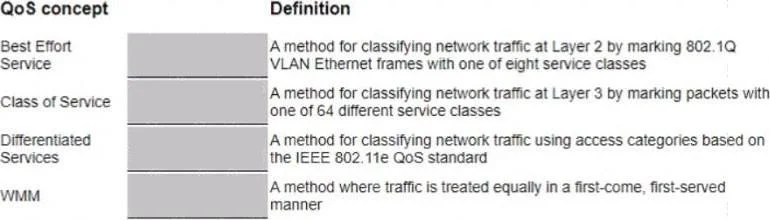
Drag and Drop Question Match the appropriate QoS concept with its definition. Answer:
The correct answer is Class of Service; Differentiated Services; WMM; Best Effort Service. QoS Concept Matching - Explanation The question matches each QoS concept to its definition. Since the definitions aren't shown, here is the technical reasoning behind each placement based on standard QoS architecture. --- Position 1 - Class of Service (CoS) What it is: A Layer…
Question
Drag and Drop Question Match the appropriate QoS concept with its definition. Answer:
Exhibit
Answer Area
Drag items
Correct arrangement
- Class of Service
- Differentiated Services
- WMM
- Best Effort Service
Explanation
QoS Concept Matching - Explanation
The question matches each QoS concept to its definition. Since the definitions aren't shown, here is the technical reasoning behind each placement based on standard QoS architecture.
Position 1 - Class of Service (CoS)
What it is: A Layer 2 QoS mechanism using the 3-bit Priority Code Point (PCP) field in 802.1Q VLAN tags. Provides 8 priority levels (0–7) for Ethernet frames.
Why it fits here: CoS operates at the data link layer - it marks traffic within a LAN segment before it reaches a router. It's the most foundational "grouping" concept - you're simply assigning a class label, not yet managing per-hop routing behavior.
Common misconception: CoS is sometimes confused with DSCP. CoS is Layer 2 (Ethernet frames); DSCP is Layer 3 (IP packets).
Position 2 - Differentiated Services (DiffServ/DSCP)
What it is: A Layer 3 QoS framework using the 6-bit DSCP field in IP packet headers. Routers apply Per-Hop Behaviors (PHBs) based on DSCP markings to provide traffic prioritization across IP networks.
Why it fits here: DiffServ is the dominant end-to-end QoS mechanism for IP networks. It extends the CoS concept beyond a single LAN segment across routed networks - a natural second position after CoS.
Common misconception: Students confuse DiffServ with IntServ (Integrated Services). IntServ reserves resources per-flow (RSVP); DiffServ classifies traffic into aggregate classes - much more scalable.
Position 3 - WMM (Wi-Fi Multimedia)
What it is: A Wi-Fi Alliance certification based on IEEE 802.11e. Defines four wireless access categories: Voice (AC_VO), Video (AC_VI), Best Effort (AC_BE), and Background (AC_BK). Prioritizes multimedia traffic over wireless.
Why it fits here: WMM is a wireless-specific QoS implementation. It sits after the wired QoS mechanisms (CoS, DiffServ) because it maps those priorities onto the wireless medium's contention-based access control (EDCA).
Common misconception: WMM does not guarantee bandwidth - it only adjusts contention parameters (TXOP, AIFS, CW values) to give higher-priority traffic a statistical advantage.
Position 4 - Best Effort Service
What it is: The default IP delivery model. No priority, no guarantees for bandwidth, delay, or delivery. Packets are processed FIFO - first in, first out.
Why it fits here: Best Effort is the baseline - it's what happens when no QoS mechanism is applied. It is placed last because it represents the absence of prioritization, serving as the contrast against which all other QoS concepts are defined.
Common misconception: Best Effort is not "broken" or "bad" - it's the standard internet model. QoS mechanisms exist to differentiate certain traffic above this baseline, not to replace it entirely.
Summary Table
| Position | Concept | Layer | Scope |
|---|---|---|---|
| 1 | Class of Service | L2 | LAN (Ethernet) |
| 2 | Differentiated Services | L3 | IP network (routed) |
| 3 | WMM | L2 wireless | Wi-Fi |
| 4 | Best Effort | N/A | Default - no QoS |
The arrangement flows logically from structured prioritization (CoS → DiffServ → WMM) down to no prioritization (Best Effort).
Topics
Community Discussion
No community discussion yet for this question.