nerdexam
HP

HPE6-A85 · Question #59

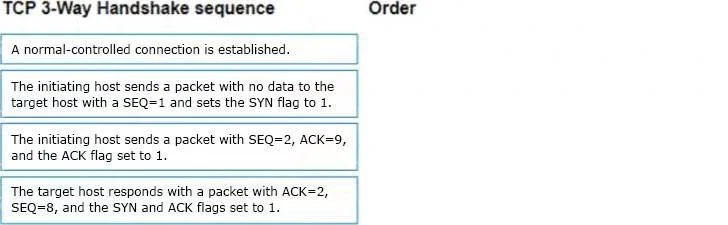
Drag and Drop Question What is the correct order of the TCP 3-Way Handshake sequence? Answer:

The correct answer is The initiating host sends a packet with no data to the target host with a SEQ=1 and sets the SYN flag to 1.; The target host responds with a packet with ACK=2, SEQ=9, and the SYN and ACK flags set to 1.; The initiating host sends a packet with SEQ=2, ACK=9, and the ACK flag set to 1.; A normal-controlled connection is established.. TCP 3-Way Handshake - Explanation The TCP 3-Way Handshake establishes a reliable, synchronized connection before any data is exchanged. The sequence numbers coordinate each side's "starting point" for tracking data. --- Step 1 - SYN (Client Initiates) > "The initiating host sends

Fundamentals of Campus Access Networking

Question

Drag and Drop Question What is the correct order of the TCP 3-Way Handshake sequence? Answer:

Exhibit
HPE6-A85 question #59 exhibit

Answer Area

Drag items

A normal-controlled connection is established.The initiating host sends a packet with no data to the target host with a SEQ=1 and sets the SYN flag to 1.The initiating host sends a packet with SEQ=2, ACK=9, and the ACK flag set to 1.The target host responds with a packet with ACK=2, SEQ=9, and the SYN and ACK flags set to 1.

Correct arrangement

  • The initiating host sends a packet with no data to the target host with a SEQ=1 and sets the SYN flag to 1.
  • The target host responds with a packet with ACK=2, SEQ=9, and the SYN and ACK flags set to 1.
  • The initiating host sends a packet with SEQ=2, ACK=9, and the ACK flag set to 1.
  • A normal-controlled connection is established.

Explanation

TCP 3-Way Handshake - Explanation

The TCP 3-Way Handshake establishes a reliable, synchronized connection before any data is exchanged. The sequence numbers coordinate each side's "starting point" for tracking data.


Step 1 - SYN (Client Initiates)

"The initiating host sends a packet with no data to the target host with a SEQ=1 and sets the SYN flag to 1."

Why first: The connection must be initiated by one side. The SYN flag signals "I want to connect." SEQ=1 is the client's Initial Sequence Number (ISN) - the baseline for tracking future data. No data is sent because no connection exists yet; this is purely a handshake packet.


Step 2 - SYN-ACK (Server Responds)

"The target host responds with a packet with ACK=2, SEQ=9, and the SYN and ACK flags set to 1."

Why second: The server must do two things simultaneously:

  • Acknowledge the client's SYNACK=2 means "I received your SEQ=1, send me byte 2 next" (ISN + 1)
  • Declare its own ISNSEQ=9 is the server's starting sequence number, also requesting synchronization

Both SYN and ACK flags are set because this packet serves dual purpose. This is the only step where both flags are active.


Step 3 - ACK (Client Confirms)

"The initiating host sends a packet with SEQ=2, ACK=9, and the ACK flag set to 1."

Why third: The client acknowledges the server's SYN-ACK:

  • SEQ=2 - client continues from where it left off (server told it to start here)
  • ACK=9 - acknowledges the server's SEQ=9, confirming the server's ISN was received
  • Only the ACK flag is set - the client is not initiating a new sync, just confirming

Step 4 - Connection Established

"A normal-controlled connection is established."

Why last: This is the result, not a packet. Once both sides have exchanged and acknowledged each other's ISNs, the connection is fully synchronized and data transfer can begin. It cannot come before the handshake completes.


Common Mistakes & Misconceptions

MistakeReality
Placing "connection established" after Step 1 or 2The connection is only established after both sides confirm each other's ISNs - requires all 3 steps
Confusing which host sends which packetStep 1 and 3 = client (initiator); Step 2 = server (target)
Thinking SYN-ACK is two separate packetsIt's one packet with both flags set simultaneously
Assuming ACK numbers equal SEQ numbersACK = received SEQ + 1 (signals the next expected byte, not a repeat of what was received)
Forgetting the handshake is for both directionsThe server also needs its ISN acknowledged - that's why there are 3 steps, not 2

Memory aid: Think of it like a phone call - "Can you hear me?" (SYN) → "Yes I hear you, can you hear me?" (SYN-ACK) → "Yes!" (ACK) → conversation begins.

Topics

#TCP#3-way handshake#SYN SYN-ACK ACK#transport layer

Community Discussion

No community discussion yet for this question.

Full HPE6-A85 Practice