HPE6-A85 · Question #57
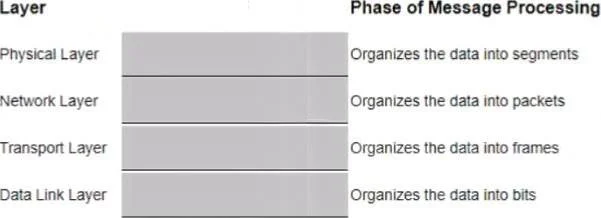
Drag and Drop Question Match the phase of message processing with the Open Systems interconnection (OSl) layer. Answer:
OSI Layer Data Units - Explained The OSI model organizes network communication into 7 layers. Each layer wraps data in a specific structure called a Protocol Data Unit (PDU). The question tests whether you know which PDU belongs to which layer. --- The Correct Mappings Transport
Question
Exhibit
Explanation
OSI Layer Data Units - Explained
The OSI model organizes network communication into 7 layers. Each layer wraps data in a specific structure called a Protocol Data Unit (PDU). The question tests whether you know which PDU belongs to which layer.
The Correct Mappings
Transport Layer → Segments
The Transport Layer (Layer 4) breaks application data into segments. It adds port numbers and sequencing info to ensure reliable, ordered delivery between processes. TCP segments are the classic example. This is the first layer that cares about end-to-end communication between applications.
Network Layer → Packets
The Network Layer (Layer 3) wraps segments into packets by adding source and destination IP addresses. Packets are the unit of logical addressing and routing - routers operate at this layer to forward packets across different networks.
Data Link Layer → Frames
The Data Link Layer (Layer 2) wraps packets into frames by adding MAC addresses (hardware addresses). Frames are used for node-to-node delivery on the same local network segment. Switches operate here.
Physical Layer → Bits
The Physical Layer (Layer 1) converts frames into raw bits (1s and 0s) and transmits them as electrical signals, light pulses, or radio waves over the physical medium (cables, fiber, Wi-Fi).
Memory Aid: "Some People Do Take Network Physical Layers" (top-down)
Or bottom-up for PDUs: Bits → Frames → Packets → Segments
Bits, Frames, Packets, Segments - "Bob's Friend Prefers Salads"
Common Mistakes
| Mistake | Why It's Wrong |
|---|---|
| Confusing packets (Layer 3) with frames (Layer 2) | Frames use MAC addresses; packets use IP addresses - different scope |
| Placing segments at Layer 3 | Segments belong to Transport (L4); Network (L3) doesn't know about ports |
| Thinking Physical Layer creates "frames" | The Physical Layer has no concept of structure - it only sees raw bits |
| Swapping Data Link and Network | Remember: MAC (local) → IP (global) going up the stack |
One-Line Summary Per Layer
- Transport (L4): How much data? → Segments (ports + sequencing)
- Network (L3): Where to send it? → Packets (IP addresses)
- Data Link (L2): Who's next hop? → Frames (MAC addresses)
- Physical (L1): How to send it? → Bits (signals on wire)
Topics
Community Discussion
No community discussion yet for this question.