
HPE6-A85 · Question #56
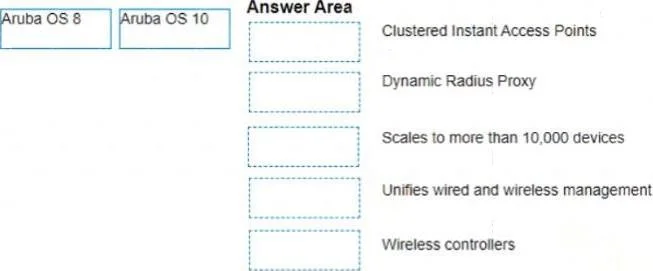
Drag and Drop Question Match the feature to the Aruba OS version (Matches may be used more than once.) Answer:
The correct answer is Aruba OS 8: Clustered Instant Access Points; Aruba OS 8: Dynamic Radius Proxy; Aruba OS 8: Scales to more than 10,000 devices; Aruba OS 8: Unifies wired and wireless management; Aruba OS 8: Wireless controllers. Aruba OS Feature Matching - Explanation This question tests knowledge of ArubaOS 8 as a platform versus older ArubaOS versions (6.x/7.x). All five features belong to ArubaOS 8 because it represented a major architectural overhaul from prior versions. --- Why Each Item Maps to…
Question
Exhibit
Answer Area
Drag items
Correct arrangement
- Aruba OS 8: Clustered Instant Access Points
- Aruba OS 8: Dynamic Radius Proxy
- Aruba OS 8: Scales to more than 10,000 devices
- Aruba OS 8: Unifies wired and wireless management
- Aruba OS 8: Wireless controllers
Explanation
Aruba OS Feature Matching - Explanation
This question tests knowledge of ArubaOS 8 as a platform versus older ArubaOS versions (6.x/7.x). All five features belong to ArubaOS 8 because it represented a major architectural overhaul from prior versions.
Why Each Item Maps to ArubaOS 8
1. Clustered Instant Access Points ArubaOS 8 introduced the ability for Instant APs (traditionally controller-less) to be managed under a clustered controller architecture. This hybrid model - where IAPs integrate with the controller cluster - did not exist in AOS 6/7.
2. Dynamic RADIUS Proxy Dynamic RADIUS Proxy is a feature specific to ArubaOS 8 that allows controllers to forward RADIUS authentication traffic dynamically based on SSID/role, rather than static proxy configurations used in older versions. It enables more flexible and scalable authentication.
3. Scales to more than 10,000 devices ArubaOS 8 introduced controller clustering (up to 4 controllers per cluster), which allows the architecture to scale to 100,000+ devices. ArubaOS 6/7 used a master-local controller model that had significantly lower device ceilings.
4. Unifies wired and wireless management ArubaOS 8 expanded beyond wireless-only management to include Aruba switches, creating a single unified management plane for both wired and wireless infrastructure. This cross-domain unification was not present in prior AOS versions.
5. Wireless Controllers While controllers have existed since early ArubaOS, this item distinguishes the AOS 8 controller-based model from alternatives like Aruba Instant (controller-less) or Aruba Central (cloud-only). In the context of this exam, it reinforces that AOS 8 retains and enhances the controller paradigm.
Common Mistakes / Misconceptions
| Misconception | Reality |
|---|---|
| "Wireless controllers belong to older ArubaOS" | Controllers exist in all versions, but the question distinguishes AOS 8's controller model from controller-less (Instant) deployments |
| "Instant APs are controller-less, so they can't be an AOS 8 feature" | AOS 8 allows IAPs to be absorbed into a controller cluster - this is the new hybrid capability |
| "Scaling is a hardware limit, not an OS feature" | The scale jump comes specifically from AOS 8's clustering software architecture |
Bottom line: ArubaOS 8 is the unifying answer here because it was the release that introduced clustering, large-scale management, wired/wireless unification, and deeper Instant AP integration - all in one platform.
Topics
Community Discussion
No community discussion yet for this question.