HPE6-A79 · Question #47
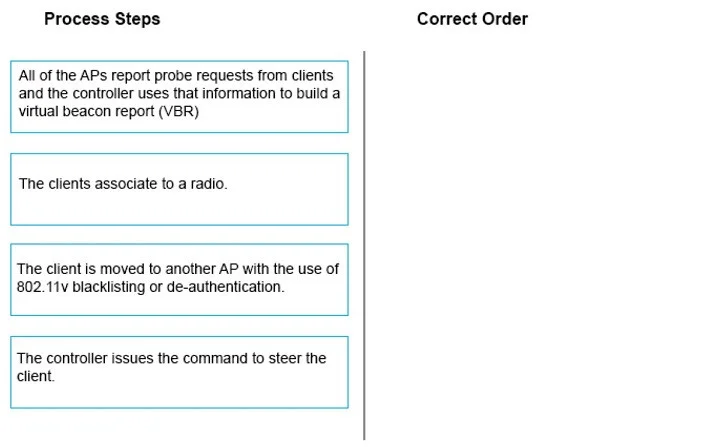
Drag and Drop Question Place the steps of the Client Match process in the correct order. (Select the Process Step, and then click the arrow button.) Select and Place: Correct Answer: Explanation Expla
The correct answer is The controller issues the command to steer the client.; The clients associate to a radio.; The client is moved to another AP with the use of 802.11v blacklisting or de-authentication.; All of the APs report probe requests from clients and the controller uses that information to build a virtual beacon report (VBR). Client Match Process - Explanation Client Match is a Cisco wireless controller feature that actively steers clients to the optimal AP/band based on RF conditions. The process is cyclic, and this question starts from the moment a steering decision has already been made. --- Why Th
Question
Drag and Drop Question Place the steps of the Client Match process in the correct order. (Select the Process Step, and then click the arrow button.) Select and Place:
Correct Answer:
Explanation Explanation/Reference:
Exhibit
Answer Area
Drag items
Correct arrangement
- The controller issues the command to steer the client.
- The clients associate to a radio.
- The client is moved to another AP with the use of 802.11v blacklisting or de-authentication.
- All of the APs report probe requests from clients and the controller uses that information to build a virtual beacon report (VBR)
Explanation
Client Match Process - Explanation
Client Match is a Cisco wireless controller feature that actively steers clients to the optimal AP/band based on RF conditions. The process is cyclic, and this question starts from the moment a steering decision has already been made.
Why This Order?
Step 1 - Controller issues the command to steer the client
The controller has already analyzed RF data from prior cycles and determined a better AP exists for this client. It acts on that decision first by sending a BSS Transition Management (802.11v) request to the client. This is the trigger that sets the rest of the process in motion.
Common mistake: Students assume the VBR (probe data collection) comes first. It does - but in the previous cycle. This question starts at the point where the controller has finished its analysis and is now acting.
Step 2 - The clients associate to a radio
After receiving the 802.11v BTM request, a compliant client proactively transitions and associates to the recommended AP. This is the preferred ("happy path") outcome - the client self-steers without being forced.
Common mistake: Assuming de-authentication happens before association. De-auth is only needed when the client ignores the steering request.
Step 3 - Client moved to another AP via 802.11v blacklisting or de-authentication
If the client did not comply with Step 2 (non-802.11v client, or client ignored the request), the controller forces the move. It blacklists the current AP via 802.11v or simply de-authenticates the client, forcing it to re-associate elsewhere.
Common mistake: Thinking this step and Step 2 are mutually exclusive. Step 2 is the attempt; Step 3 is the fallback enforcement.
Step 4 - APs report probe requests; controller builds VBR
Once the client has settled on an AP, all nearby APs that heard the client's probes report that data to the controller. The controller uses this to build/update the Virtual Beacon Report, which feeds the next steering decision cycle.
Common mistake: Placing this step first. The VBR build is the output of this cycle and the input for the next - it's the "reset" that enables continuous optimization.
Summary of the Cycle
[Prior cycle VBR] → Issue steering command → Client associates (802.11v)
→ Force move if needed (de-auth/blacklist) → Rebuild VBR → repeat
The question captures one full iteration starting mid-cycle from the steering decision, not from the very beginning of the feature's lifetime.
Topics
Community Discussion
No community discussion yet for this question.
