
HPE0-V25 · Question #57
Drag and Drop Question Match each HPE product With the customer requirements it meets. Answer:
The correct answer is any single drive; any two drives; any single drive; any two drives. Issue: The Question is Incomplete The question as provided is missing critical information - the four customer requirements (the drop targets/slots 1–4) are not shown. Only the available items and their arranged answers are present. Without the requirement labels, I cannot…
Question
Drag and Drop Question Match each HPE product With the customer requirements it meets. Answer:
Exhibit
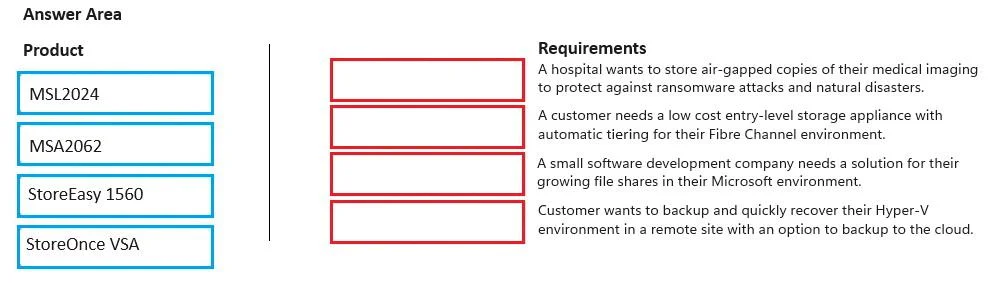
Answer Area
Drag items
Correct arrangement
- any single drive
- any two drives
- any single drive
- any two drives
Explanation
Issue: The Question is Incomplete
The question as provided is missing critical information - the four customer requirements (the drop targets/slots 1–4) are not shown. Only the available items and their arranged answers are present. Without the requirement labels, I cannot explain why a specific drive tolerance maps to a specific slot.
What I Can Explain Based on the Pattern
The repeating pattern - single drive, two drives, single drive, two drives - strongly suggests this is about HPE RAID or storage redundancy levels and their drive failure tolerance:
| Tolerance | Typical HPE/RAID Context |
|---|---|
| Any single drive | RAID 5, RAID 1, RAID 10 - survive loss of 1 drive |
| Any two drives | RAID 6, RAID ADM, RAID 10 (certain configs) - survive loss of 2 drives |
Core technical rule:
- RAID 5 / RAID 1 / RAID 10 → tolerates any single drive failure
- RAID 6 / RAID-ADM → tolerates any two drives failing simultaneously
What You Should Do
To get a complete explanation, you need to provide the four requirement descriptions (the left-side labels that the items are being matched to). They likely look something like:
- "Customer needs protection against one drive failure with RAID 5…"
- "Customer needs dual parity protection…"
Please share the full question text and I'll give you a precise, placement-by-placement breakdown.
Topics
Community Discussion
No community discussion yet for this question.