
HPE0-V25 · Question #55
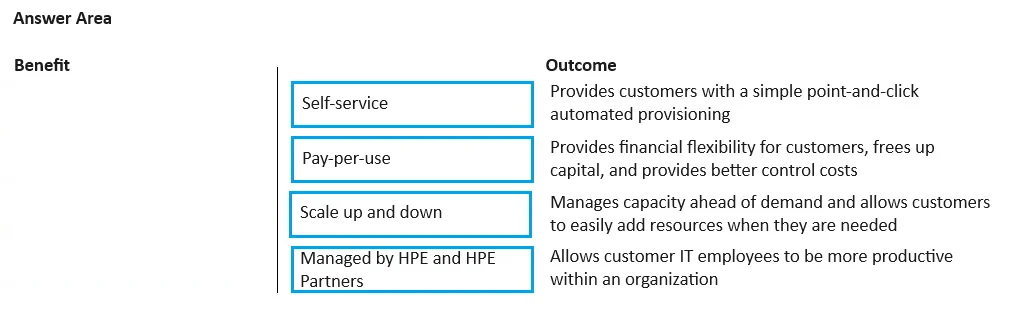
Drag and Drop Question Your customer asks you to explain the benefits that the HPE GreenLake consumption model can provide. Match the GreenLake benefits to their outcomes. Answer:
The correct answer is Self-service; Pay-per-use; Scale up and down; Managed by HPE and HPE Partners. HPE GreenLake Consumption Model - Drag-and-Drop Explanation Important note: The question references matching benefits to outcomes, but the outcome descriptions weren't captured in what you shared. The "correct arrangement" (1–4) is the answer key showing which benefit belongs…
Question
Drag and Drop Question Your customer asks you to explain the benefits that the HPE GreenLake consumption model can provide. Match the GreenLake benefits to their outcomes. Answer:
Exhibit
Answer Area
Drag items
Correct arrangement
- Self-service
- Pay-per-use
- Scale up and down
- Managed by HPE and HPE Partners
Explanation
HPE GreenLake Consumption Model - Drag-and-Drop Explanation
Important note: The question references matching benefits to outcomes, but the outcome descriptions weren't captured in what you shared. The "correct arrangement" (1–4) is the answer key showing which benefit belongs in each slot. Below I explain each item's placement and its associated outcome logic.
The Four GreenLake Benefit Pillars
1. Self-service
What it means: Users provision and manage resources through the GreenLake Central portal without raising IT tickets or waiting for procurement cycles. Outcome: Speed and agility - teams get resources on-demand, reducing time-to-value. Why it's first: Self-service is the user-facing entry point; it's how customers interact with the model before anything else (billing, scaling, management) comes into play.
2. Pay-per-use
What it means: Billing is consumption-based - you pay only for what you actually use, measured and metered monthly. Outcome: Cost optimization / OpEx model - eliminates over-provisioning and converts capital expenditure (CapEx) to operational expenditure (OpEx). Why it's second: After self-service grants access, the financial model determines how you're charged for that usage.
3. Scale up and down
What it means: Capacity can be elastically grown or reduced to match fluctuating demand, with a pre-provisioned buffer available immediately. Outcome: Flexibility / elasticity - avoids both over-provisioning (waste) and under-provisioning (outages). Why it's third: Scaling is the operational benefit enabled by the pay-per-use model - you scale because you're only billed for what you use.
4. Managed by HPE and HPE Partners
What it means: HPE (or a certified partner) handles installation, monitoring, patching, and lifecycle management of the infrastructure on-premises or in a colocation. Outcome: Reduced operational burden - customer IT staff focus on business outcomes rather than infrastructure management. Why it's last: This is the support layer underneath everything else - it's what makes the first three benefits sustainable long-term without increasing the customer's IT headcount.
Common Mistakes & Misconceptions
| Mistake | Why It's Wrong |
|---|---|
| Confusing Pay-per-use with Scale up and down | Pay-per-use is the billing model; scaling is the operational capability - they're distinct benefits |
| Thinking Managed by HPE means public cloud | GreenLake runs on-premises or in colo - HPE manages your hardware where you need it |
| Placing Self-service last | Self-service is the customer-facing access layer, not an afterthought |
| Assuming Scale up and down is only scale-up | GreenLake explicitly supports scale-down, which is key to the cost savings story |
Summary mnemonic: Access → Pay → Flex → Relax (Self-service → Pay-per-use → Scale → Managed)
Topics
Community Discussion
No community discussion yet for this question.