
HP0-J67 · Question #5
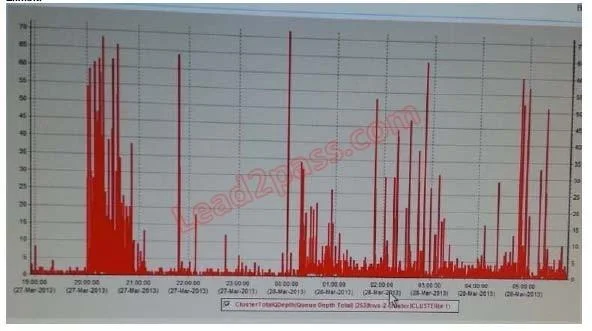
Refer to the exhibit. A customer complains about poor application performance on their existing two-node HP P4500 Virtualization SAN and provides you the chart in the exhibit. Wich conclusion can…
The correct answer is D. Queue depth of the cluster exceeds the recommend limit. and total disk I/O should be checked. The unprovided graph, when indicating poor application performance, must show that the storage queue depth is excessively high, signaling an overwhelmed system. This high queue depth necessitates further investigation into the total disk I/O to understand the load.
Question
Refer to the exhibit. A customer complains about poor application performance on their existing two-node HP P4500 Virtualization SAN and provides you the chart in the exhibit. Wich conclusion can you draw from this graph?
Exhibit
Options
- AQueue depth of the storage cluster is in the optimal range, and throughput should be checked
- BQueue depth is acceptable, and total latency peaks are too High during business hours
- CQueue depth of the storage environment is acceptable, and performance issues should be checked
- DQueue depth of the cluster exceeds the recommend limit. and total disk I/O should be checked
How the community answered
(22 responses)- A32% (7)
- B9% (2)
- C14% (3)
- D45% (10)
Why each option
The unprovided graph, when indicating poor application performance, must show that the storage queue depth is excessively high, signaling an overwhelmed system. This high queue depth necessitates further investigation into the total disk I/O to understand the load.
This option contradicts the premise of poor application performance and the likely visual cues of a problematic queue depth on the exhibit.
Stating that queue depth is acceptable directly contradicts the problem description (poor performance) and the correct answer (D) which indicates it exceeds limits.
Similar to option B, asserting that queue depth is acceptable is inconsistent with a reported performance issue and the conclusion that the queue depth is actually problematic.
If the queue depth of the storage cluster consistently exceeds its recommended operational limit, it signifies that the storage system is receiving more I/O requests than it can efficiently process, leading to increased latency and performance degradation. When this occurs, analyzing the total disk I/O (IOPS and throughput) is crucial to determine the exact workload contributing to the saturation and pinpoint specific bottlenecks.
Concept tested: SAN performance analysis - Queue Depth
Topics
Community Discussion
No community discussion yet for this question.