
HCISPP · Question #263
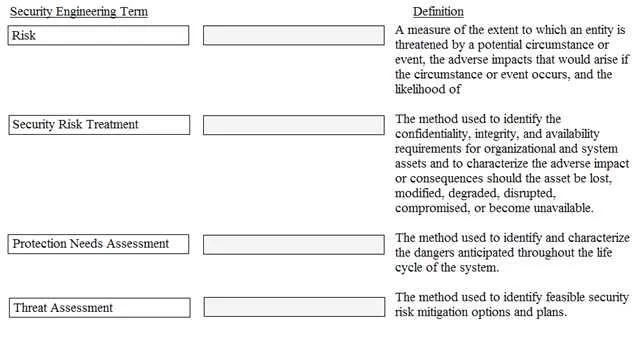
Drag and Drop Question Drag the following Security Engineering terms on the left to the BEST definition on the right. Answer:
The correct answer is Risk; Protection Needs Assessment; Threat Assessment; Security Risk Treatment. This drag-and-drop question requires matching fundamental security engineering terms to their correct definitions to test knowledge of risk management concepts.
Question
Exhibit
Answer Area
Drag items
Correct arrangement
- Risk
- Protection Needs Assessment
- Threat Assessment
- Security Risk Treatment
Explanation
This drag-and-drop question requires matching fundamental security engineering terms to their correct definitions to test knowledge of risk management concepts.
Approach. The correct interaction involves dragging each security engineering term from the left column to its best-matching definition in the right column, as depicted in the second exhibit image. Here's the correct mapping and reasoning:
-
Drag 'Risk' to its definition: 'A measure of the extent to which an entity is threatened by a potential circumstance or event, the adverse impacts that would arise if the circumstance or event occurs, and the likelihood of'. This definition accurately describes risk as a combination of potential impact and likelihood, a standard concept in risk management.
-
Drag 'Protection Needs Assessment' to its definition: 'The method used to identify the confidentiality, integrity, and availability requirements for organizational and system assets and to characterize the adverse impact or consequences should the asset be lost, modified, degraded, disrupted, compromised, or become unavailable.' This definition correctly identifies a protection needs assessment as focusing on an asset's CIA (Confidentiality, Integrity, Availability) requirements and the impact of their compromise.
-
Drag 'Threat Assessment' to its definition: 'The method used to identify and characterize the dangers anticipated throughout the life cycle of the system.' A threat assessment's primary goal is to identify and understand 'dangers' or potential threats to a system, which aligns perfectly with this definition.
-
Drag 'Security Risk Treatment' to its definition: 'The method used to identify feasible security risk mitigation options and plans.' Security risk treatment involves deciding how to address identified risks, which commonly includes developing and implementing mitigation strategies or plans. This definition directly describes that process.
Common mistakes.
-
common_mistake. Common mistakes often involve confusing similar-sounding terms or their nuances. For example:
-
Confusing 'Threat Assessment' with 'Protection Needs Assessment': A threat assessment focuses on external dangers and potential attacks, whereas a protection needs assessment focuses on the internal requirements (CIA) of assets and the consequences if those requirements are not met. Swapping these would be incorrect because one looks outward at threats, the other inward at asset value and impact.
-
Misinterpreting 'Security Risk Treatment': Some might confuse it with the general concept of 'Risk' itself. However, 'Risk' is the measurement of potential harm, while 'Security Risk Treatment' refers specifically to the actions taken to manage that risk (e.g., mitigation, avoidance, acceptance, transfer). Placing 'Risk Treatment' with the overall definition of risk would be wrong because treatment implies an active response or plan.
Concept tested. Understanding fundamental security engineering terminology and the core components of risk management, including risk definition, threat identification, asset protection requirements, and risk treatment strategies.
Topics
Community Discussion
No community discussion yet for this question.