
HCISPP · Question #262
Drag and Drop Question Place in order, from BEST (1) to WORST (4), the following methods to reduce the risk of data remanence on magnetic media. Answer:
The correct answer is Overwriting; Degaussing; Destruction; Deleting. The question requires ranking data sanitization methods for magnetic media from best (most effective) to worst (least effective) to prevent data remanence.
Question
Drag and Drop Question Place in order, from BEST (1) to WORST (4), the following methods to reduce the risk of data remanence on magnetic media. Answer:
Exhibit
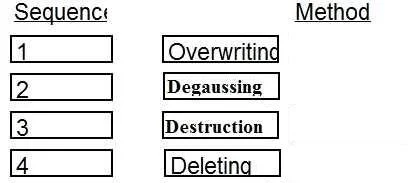
Answer Area
Drag items
Correct arrangement
- Overwriting
- Degaussing
- Destruction
- Deleting
Explanation
The question requires ranking data sanitization methods for magnetic media from best (most effective) to worst (least effective) to prevent data remanence.
Approach. To correctly answer this question, one must understand the various methods of data sanitization and their effectiveness specifically for magnetic media in preventing data remanence. The correct order from BEST (1) to WORST (4) is:
- Destruction: This is the most effective method. Physically destroying the media (e.g., shredding, pulverizing, incineration) makes data absolutely unrecoverable.
- Degaussing: For magnetic media, degaussing involves applying a strong magnetic field to randomize the magnetic patterns on the storage device. This effectively renders all data unrecoverable without physically destroying the device itself. While highly effective, it typically makes the media unusable.
- Overwriting: This method involves writing new data (e.g., zeros, ones, or random patterns) over the original data, often multiple times. While significantly more effective than simple deletion, advanced forensic techniques might still recover some residual data, especially from older or partially overwritten sectors.
- Deleting: Simply 'deleting' files or formatting a drive typically only removes pointers to the data and marks the space as available. The actual data often remains on the media and can be easily recovered using data recovery tools until it is overwritten. This is the least effective method for preventing data remanence.
Therefore, the correct interaction is to drag 'Destruction' to Sequence 1, 'Degaussing' to Sequence 2, 'Overwriting' to Sequence 3, and 'Deleting' to Sequence 4.
Common mistakes.
- common_mistake. A common mistake is confusing 'deleting' with actual data sanitization. Many believe that deleting a file or formatting a drive makes the data disappear, which is not true for preventing remanence. Another mistake is underestimating the effectiveness of physical destruction or degaussing. Placing 'Overwriting' as the best method, or 'Degaussing' below 'Overwriting' would be incorrect because degaussing provides a higher level of assurance for magnetic media by physically altering the magnetic state of the platters, making recovery extremely difficult or impossible, compared to overwriting which might still leave forensic traces. Any order that does not place 'Destruction' as 1 and 'Deleting' as 4, or incorrectly ranks 'Degaussing' and 'Overwriting' for magnetic media, would be wrong.
Concept tested. Data sanitization, data remanence, secure media disposal, and information security best practices related to data confidentiality on magnetic storage media.
Topics
Community Discussion
No community discussion yet for this question.