
H31-161 · Question #29
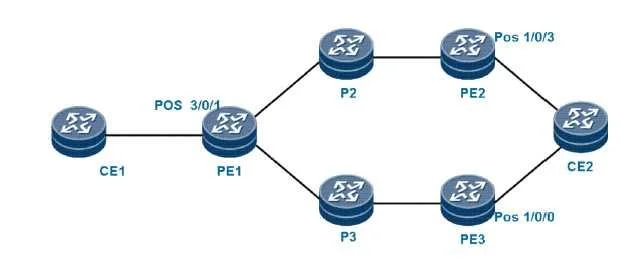
As shown in the figure, the asymmetric VLL FRR networking is used. AC interfaces on PE 1, PE 2, and PE 3 are configured as follows: Configuration of the AC interface on PE 1: interface…
The correct answer is A. The PW between PE 1 and PE 2 is the primary PW. B. If a forwarding fault is detected on the PW between PE 1 and PE 2, traffic can be switched to the C. If a forwarding fault is detected on the PW between PE 1 and PE 2, traffic from CE 1 to CE 2 can. See the full explanation below for the reasoning.
Question
As shown in the figure, the asymmetric VLL FRR networking is used. AC interfaces on PE 1, PE 2, and PE 3 are configured as follows:
Configuration of the AC interface on PE 1:
interface Pos3/0/1link-protocol ppp undo shutdown oam detect lcp-terminal notify lcp-terminal ip address 208.1.1.1 255.255.255.0 ip address 208.2.2.1 255.255.255.0 sub mpls l2vc pw-template pw1 13579 ip-interworking mpls l2vc pw-template pw2 24680 ip-interworking secondary mpls l2vpn oam-mapping mpls l2vpn reroute immediately resume 0 Configuration of the AC interface on PE 2:
interface Pos1/0/3 link-protocol ppp undo shutdown ip address 208.1.1.2 255.255.255.0 mpls l2vc pw-template pw1 13579 ip-interworking mpls l2vpn oam-mapping Configuration of the AC interface on PE 3:
interface Pos1/0/0 link-protocol hdlc undo shutdown oam detect hello-stop notify hello-stop ip address 208.2.2.2 255.255.255.0 mpls l2vc pw-template pw1 24680 ip-interworking mpls l2vpn oam-mapping Which of the following statements are true on the condition that IGP and MPLS are configured correctly on the public network?
Exhibit
Options
- AThe PW between PE 1 and PE 2 is the primary PW.
- BIf a forwarding fault is detected on the PW between PE 1 and PE 2, traffic can be switched to the
- CIf a forwarding fault is detected on the PW between PE 1 and PE 2, traffic from CE 1 to CE 2 can
- DIf a forwarding fault is detected on the public network side of the PW between PE 1 and PE 2,
How the community answered
(38 responses)- A74% (28)
- D26% (10)
Community Discussion
No community discussion yet for this question.