
H31-161 · Question #184
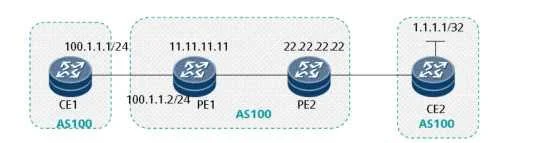
Refer to the exhibit. As shown in the figure, PE 1 sets up an MP-IBGP neighbor relationship with PE 2 and they communicate over MPLS LDP. A CE communicates with a PE over OSPF. Configure the VRF on…
The correct answer is D. BGP routes must be imported to OSPF areas on a PE. See the full explanation below for the reasoning.
Question
Refer to the exhibit. As shown in the figure, PE 1 sets up an MP-IBGP neighbor relationship with PE 2 and they communicate over MPLS LDP. A CE communicates with a PE over OSPF. Configure the VRF on PE 1 as follows:
ip vpn-instance vrf1 route-distinguisher 100:1 vpn-target 1:1 export-extcommunity vpn-target 1:1 import-extcommunityConfigure OSPF on PE 1 as follows:
ospf 1 vpn-instance vrf1 area 0.0.0.0 network 100.1.1.0 0.0.0.255 Configure BGP on PE 1 as follows:
bgp 100 peer 22.22.22.22 as-number 100 peer 22.22.22.22 connect-interface LoopBack0 # ipv4-family unicast undo synchronization peer 22.22.22.22 enable # ipv4-family vpnv4 policy vpn-target peer 22.22.22.22 enable # ipv4-family vpn-instance vrf1 import-route ospf 1 PE 2 has the same configurations as PE 1. MP-IBGP neighbor relationships have been set up between PEs, and OSPF neighbor relationships have been set up between PEs and CEs. A valid route 1.1.1.1/32 is imported from CE 1 to an OSPF area, but CE 1 does not learn the route. What is the reason?
Exhibit
Options
- ACE cannot be connected to a PE through OSPF.
- BCE can be connected to a PE through OSPF only when the PE also runs OSPF.
- CAn RD is shared by VRFs on PE 1 and PE 2.
- DBGP routes must be imported to OSPF areas on a PE.
How the community answered
(41 responses)- A7% (3)
- B2% (1)
- C17% (7)
- D73% (30)
Community Discussion
No community discussion yet for this question.