
H12-891_V1.0 · Question #114
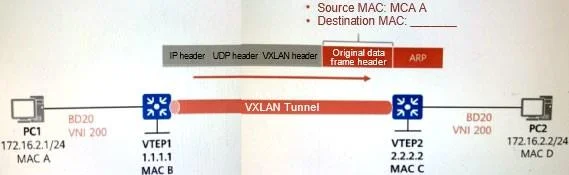
PC1 has learned the ARP information of PC2. When the ARP request sent by PC1 for PC2 is forwarded by VTEP1 to VTEP2, which of the following is the destination MAC address of the inner data frame?
The correct answer is B. MAC D. Option B is correct because, in VXLAN encapsulation, the inner data frame preserves the original Layer 2 communication between end hosts - and since PC1 has already resolved PC2's MAC address via ARP, PC1 addresses the inner frame's destination directly to MAC B (PC2's MAC)…
Question
PC1 has learned the ARP information of PC2. When the ARP request sent by PC1 for PC2 is forwarded by VTEP1 to VTEP2, which of the following is the destination MAC address of the inner data frame?
Exhibit
Options
- AMAC A
- BMAC D
- CMAC C
- DMAC B
How the community answered
(26 responses)- A12% (3)
- B77% (20)
- C8% (2)
- D4% (1)
Explanation
Option B is correct because, in VXLAN encapsulation, the inner data frame preserves the original Layer 2 communication between end hosts - and since PC1 has already resolved PC2's MAC address via ARP, PC1 addresses the inner frame's destination directly to MAC B (PC2's MAC). VTEP1 then wraps this entire frame in an outer VXLAN header for tunnel transport.
- MAC A is PC1's own MAC - it appears as the inner frame's source, not destination.
- MAC C and MAC D are VTEP MAC addresses - these belong to the outer encapsulation header (VTEP-to-VTEP transport), not the inner host-to-host frame.
Memory tip: Think in two layers - "inner = host-to-host, outer = VTEP-to-VTEP." The inner frame never changes its host MACs regardless of how many tunnels it traverses; the VTEP MACs only live in the outer wrapper.
Topics
Community Discussion
No community discussion yet for this question.