
H12-891_V1.0 · Question #113
As shown in the figure, the gateway of the PC is located on the aggregation switch. If you want to implement load sharing on the gateway device, which of the following descriptions is wrong?
The correct answer is C. The VRID parameter only has local meaning, so the VRID of two aggregation switches for the. Option C is the wrong description because VRID (Virtual Router ID) is NOT locally significant - it must match on all devices participating in the same VRRP backup group. Switches that share a VRID on the same network segment form a single VRRP group and elect one master…
Question
As shown in the figure, the gateway of the PC is located on the aggregation switch. If you want to implement load sharing on the gateway device, which of the following descriptions is wrong?
Exhibit
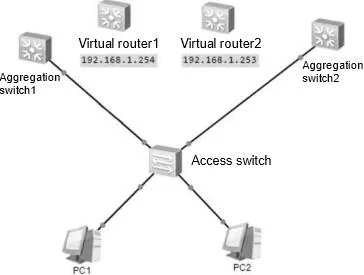
Options
- ASet different gateway addresses on the PC so that traffic is evenly sent to different gateways.
- BYou need to configure priorities so that the aggregation switch becomes the master device of the
- CThe VRID parameter only has local meaning, so the VRID of two aggregation switches for the
- DMultiple VRRP backup groups need to be configured on the six aggregation switches.
How the community answered
(39 responses)- A8% (3)
- B13% (5)
- C74% (29)
- D5% (2)
Explanation
Option C is the wrong description because VRID (Virtual Router ID) is NOT locally significant - it must match on all devices participating in the same VRRP backup group. Switches that share a VRID on the same network segment form a single VRRP group and elect one master; mismatched VRIDs mean the devices cannot recognize each other as group members, breaking the protocol entirely.
Why the distractors are correct descriptions (and therefore not the answer):
- A is a valid load-sharing method - assigning different virtual gateway IPs (from different VRRP groups) to different PCs distributes traffic across both switches.
- B is correct - priority values determine which switch becomes the master for each VRRP group; without explicit priority tuning, load sharing between switches won't work as intended.
- D is correct - multiple VRRP groups are required so that Switch A is master for Group 1 while Switch B is master for Group 2 (and vice versa as backups), achieving actual load distribution.
Memory tip: Contrast VRRP's VRID with VLAN IDs in VTP - VLAN IDs propagate automatically and can be centrally managed, but VRID must be manually matched on every device in the group. If the VRID doesn't match, the switches are "strangers" that cannot form a redundancy group. The rule: same group = same VRID, always.
Topics
Community Discussion
No community discussion yet for this question.