
GSEC · Question #144
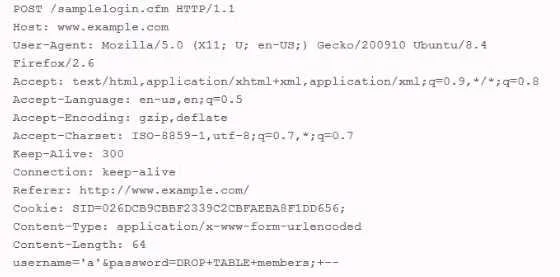
While using Wire shark to investigate complaints of users being unable to login to a web application, you come across an HTTP POST submitted through your web application. The contents of the POST…
The correct answer is D. Use https to prevent hackers from inserting malware. When HTTP POST data containing credentials is visible in Wireshark, it indicates unencrypted traffic that requires HTTPS to protect data in transit.
Question
While using Wire shark to investigate complaints of users being unable to login to a web application, you come across an HTTP POST submitted through your web application. The contents of the POST are listed below. Based on what you see below, which of the following would you recommend to prevent future damage to your database?
Exhibit
Options
- AUse ssh to prevent a denial of service attack
- BSanitize user inputs to prevent injection attacks
- CAuthenticate users to prevent hackers from using your database
- DUse https to prevent hackers from inserting malware
How the community answered
(51 responses)- A2% (1)
- B8% (4)
- C6% (3)
- D84% (43)
Why each option
When HTTP POST data containing credentials is visible in Wireshark, it indicates unencrypted traffic that requires HTTPS to protect data in transit.
SSH is a protocol for secure remote shell access and is not applicable to protecting web application login traffic or mitigating denial-of-service attacks against databases.
Sanitizing user inputs defends against injection attacks such as SQL injection, but does not address the underlying problem of credentials being transmitted in unencrypted plaintext over HTTP.
Requiring user authentication enforces access control but does not protect credentials that are already being exposed in plaintext during transmission and captured via network analysis.
If an HTTP POST containing login credentials or session data is readable in Wireshark, the web application is transmitting data in plaintext over unencrypted HTTP, making it trivially interceptable by an attacker on the network. Implementing HTTPS encrypts all traffic in transit using TLS, preventing attackers from capturing and reading credentials or session tokens via packet capture. This directly addresses the interception attack vector that Wireshark visibility reveals.
Concept tested: HTTPS encryption to protect web application credentials in transit
Source: https://learn.microsoft.com/en-us/azure/security/fundamentals/network-best-practices
Topics
Community Discussion
No community discussion yet for this question.