
GCIH · Question #814
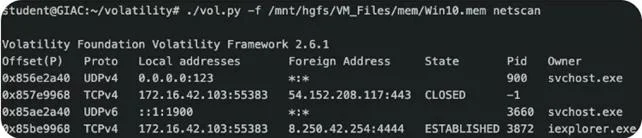
Which of the following is a suspicious entry in the Volatility output attached?
The correct answer is D. Closed connection to a web server with no owner process. In memory forensics, a network connection with no associated owner process is a strong indicator of malicious activity or process injection.
Question
Which of the following is a suspicious entry in the Volatility output attached?
Exhibit
Options
- AInvalid IP address of the second Svchost connection
- BIncorrect owner for the UDP listening port for PID 900
- CUnusual port used for the TCP connection for PID 3872
- DClosed connection to a web server with no owner process
How the community answered
(31 responses)- A13% (4)
- B6% (2)
- C19% (6)
- D61% (19)
Why each option
In memory forensics, a network connection with no associated owner process is a strong indicator of malicious activity or process injection.
Svchost.exe legitimately maintains multiple outbound connections to Microsoft-owned IP addresses, so a second connection is not inherently invalid without specific evidence the IP is malformed or non-routable.
PID 900 on a given system may legitimately own a UDP listening port depending on which Windows service is assigned to that PID, making this non-conclusive without further service-to-PID mapping.
An unusual port for PID 3872 is context-dependent and requires knowing what application owns that PID and its expected communication behavior before it can be considered suspicious.
A closed TCP connection to a web server with no owner process is suspicious because every legitimate network connection should map to a running process in memory; the absence of an owning process suggests the malicious process terminated after establishing the connection, performed process injection to hide itself, or used kernel-level techniques to obscure its network activity.
Concept tested: Memory forensics network connection anomaly detection
Topics
Community Discussion
No community discussion yet for this question.