
FCSS_SASE_AD-23 · Question #29
Refer to the exhibits. Win10-Pro and Win7-Pro are endpoints from the same remote location. Win10-Pro can access the internet though FortiSASE, while Win7-Pro can no longer access the internet. Given…
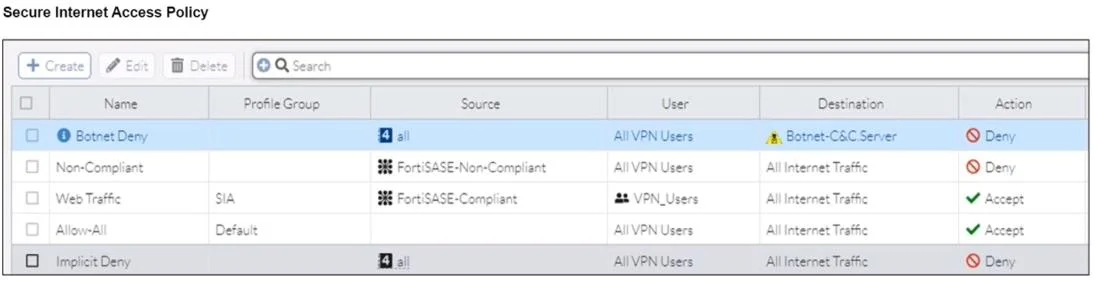
The correct answer is A. The Win7-Pro device posture has changed. In the "Managed Endpoints" table, the ZTNA tags show that Win7-Pro is marked as Non- Compliant, whereas Win10-Pro is Compliant. In the "Secure Internet Access Policy," there is a policy for Non-Compliant devices that denies internet traffic for these devices. As a result, the…
Question
Refer to the exhibits. Win10-Pro and Win7-Pro are endpoints from the same remote location. Win10-Pro can access the internet though FortiSASE, while Win7-Pro can no longer access the internet. Given the exhibits, which reason explains the outage on Win7-Pro?
Exhibits

Options
- AThe Win7-Pro device posture has changed.
- BWin7-Pro cannot reach the FortiSASE SSL VPN gateway
- CThe Win7-Pro FortiClient version does not match the FortiSASE endpoint requirement.
- DWin-7 Pro has exceeded the total vulnerability detected threshold.
How the community answered
(48 responses)- A75% (36)
- B8% (4)
- C13% (6)
- D4% (2)
Explanation
In the "Managed Endpoints" table, the ZTNA tags show that Win7-Pro is marked as Non- Compliant, whereas Win10-Pro is Compliant. In the "Secure Internet Access Policy," there is a policy for Non-Compliant devices that denies internet traffic for these devices. As a result, the Win7-Pro device is blocked from accessing the internet due to its non-compliant status.
Topics
Community Discussion
No community discussion yet for this question.