
FCSS_CDS_AR-7.6 · Question #39
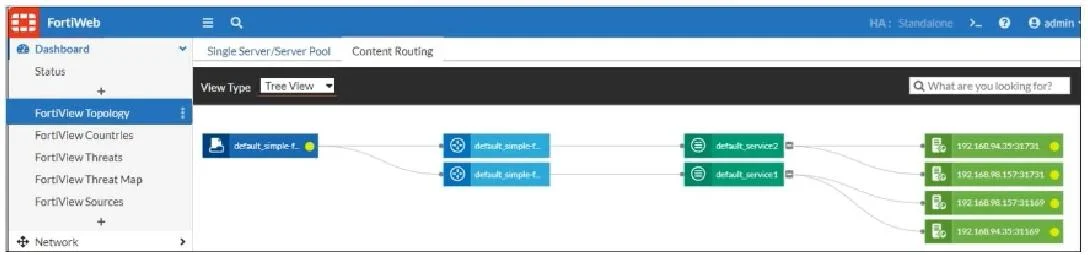
Refer to the exhibit. An administrator implements FortiWeb ingress controller to protect containerized web applications in an AWS Elastic Kubernetes Service (EKS) cluster. What can you conclude…
The correct answer is A. The FortiWeb VM gets the latest cluster information through an SDN connector. Option A is correct because FortiWeb uses an SDN (Software Defined Networking) connector to dynamically query the EKS cluster API, retrieving real-time information about nodes, pods, and services. This connector is what enables FortiWeb to stay synchronized with the Kubernetes…
Question
Refer to the exhibit. An administrator implements FortiWeb ingress controller to protect containerized web applications in an AWS Elastic Kubernetes Service (EKS) cluster. What can you conclude about the topology shown in FortiView?
Exhibit
Options
- AThe FortiWeb VM gets the latest cluster information through an SDN connector.
- BThis topology has two services and two ingress controllers deployed.
- CBoth services will be load balanced among the two nodes and the four pods.
- DAdding a new service will update the FortiWeb configuration automatically.
How the community answered
(46 responses)- A76% (35)
- B7% (3)
- C13% (6)
- D4% (2)
Explanation
Option A is correct because FortiWeb uses an SDN (Software Defined Networking) connector to dynamically query the EKS cluster API, retrieving real-time information about nodes, pods, and services. This connector is what enables FortiWeb to stay synchronized with the Kubernetes environment and populate the FortiView topology display.
Option B is wrong because a FortiWeb ingress controller deployment uses a single ingress controller instance - FortiWeb itself acts as the sole ingress controller, not one of two. Multiple services can exist behind it, but that doesn't mean multiple ingress controllers are deployed.
Option C is wrong because FortiWeb routes traffic to Kubernetes services, which then distribute to their respective pods; not every service is load balanced across all nodes and all pods - only those pods that belong to that specific service's selector.
Option D is wrong because adding a new Kubernetes service alone does not automatically trigger FortiWeb policy creation. A corresponding Kubernetes Ingress resource (with FortiWeb annotations) must be created to instruct FortiWeb to protect and configure rules for the new service.
Memory tip: Think of the SDN connector as FortiWeb's "eyes" into the cluster - it sees (reads) the cluster state for FortiView visibility, but FortiWeb only acts (creates protection policies) when an Ingress object explicitly tells it to. Seeing ≠ protecting.
Topics
Community Discussion
No community discussion yet for this question.