E10-001 · Question #79
What is a benefit of block-level storage virtualization?
The correct answer is A. Enables users to perform nondisruptive data migrations. Block Level Storage Virtualization Block-level storage virtualization aggregates block storage devices (LUNs) and enables provisioning of virtual storage volumes, independent of the underlying physical storage. A virtualization layer, which exists at the SAN, abstracts the…
Question
What is a benefit of block-level storage virtualization?
Exhibit
Options
- AEnables users to perform nondisruptive data migrations
- BEnables users to automatically perform zoning changes
- CReduces application downtime during backups
- DEnables hosts to perform online path management
How the community answered
(52 responses)- A75% (39)
- B6% (3)
- C15% (8)
- D4% (2)
Explanation
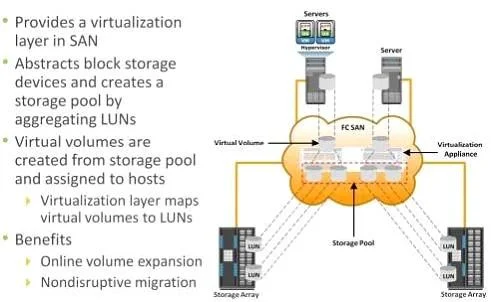
Block Level Storage Virtualization Block-level storage virtualization aggregates block storage devices (LUNs) and enables provisioning of virtual storage volumes, independent of the underlying physical storage. A virtualization layer, which exists at the SAN, abstracts the identity of physical storage devices and creates a storage pool from heterogeneous storage devices. Virtual volumes are created from the storage pool and assigned to the hosts. Instead of being directed to the LUNs on the individual storage arrays, the hosts are directed to the virtual volumes provided by the virtualization layer. For hosts and storage arrays, the virtualization layer appears as the target and initiator devices, respectively. The virtualization layer maps the virtual volumes to the LUNs on the individual arrays. The hosts remain unaware of the mapping operation and access the virtual volumes as if they were accessing the physical storage attached to them. Typically, the virtualization layer is managed via a dedicated virtualization appliance to which the hosts and the storage arrays are connected. Figure in the slide illustrates a virtualized environment. It shows two physical servers, each of which has one virtual volume assigned. These virtual volumes are used by the servers. These virtual volumes are mapped to the LUNs in the storage arrays. When an I/O is sent to a virtual volume, it is redirected through the virtualization layer at the storage network to the mapped LUNs. Depending on the capabilities of the virtualization appliance, the architecture may allow for more complex mapping between array LUNs and virtual volumes. Block-level storage virtualization enables extending the storage volumes online to meet application growth requirements. It consolidates heterogeneous storage arrays and enables transparent volume access. Block-level storage virtualization also provides the advantage of nondisruptive data migration. In a traditional SAN environment, LUN migration from one array to another is an offline event because the hosts needed to be updated to reflect the new array configuration. In other instances, host CPU cycles were required to migrate data from one array to the other, especially in a multivendor environment. With a block-level virtualization solution in place, the virtualization layer handles the back-end migration of data, which enables LUNs to remain online and accessible while data is migrating. No physical changes are required because the host still points to the same virtual targets on the virtualization layer. However, the mappings information on the virtualization layer should be changed. These changes can be executed dynamically and are transparent to the end user.
Topics
Community Discussion
No community discussion yet for this question.
