nerdexam
Microsoft

DP-300 · Question #92

Case Study 4 - A.Datum Overview ADatum Corporation is a retailer that sells products through two sales channels: retail stores and a website. Existing Environment ADatum has one database server that…

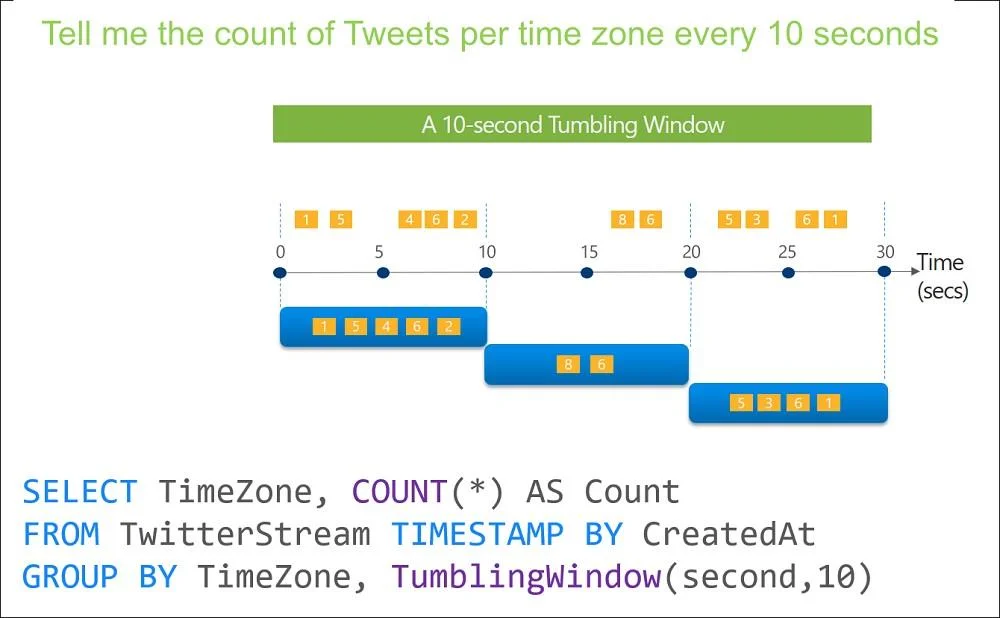
The correct answer is D. Tumbling. Scenario: The sales data, including the documents in JSON format, must be gathered as it arrives and analyzed online by using Azure Stream Analytics. The analytics process will perform aggregations that must be done continuously, without gaps, and without overlapping. Tumbling…

Submitted by parkjh· Mar 6, 2026Develop data processing

Question

Case Study 4 - A.Datum Overview ADatum Corporation is a retailer that sells products through two sales channels: retail stores and a website. Existing Environment ADatum has one database server that has Microsoft SQL Server 2016 installed. The server hosts three mission-critical databases named SALESDB, DOCDB, and REPORTINGDB. SALESDB collects data from the stores and the website. DOCDB stores documents that connect to the sales data in SALESDB. The documents are stored in two different JSON formats based on the sales channel. REPORTINGDB stores reporting data and contains several columnstore indexes. A daily process creates reporting data in REPORTINGDB from the data in SALESDB. The process is implemented as a SQL Server Integration Services (SSIS) package that runs a stored procedure from SALESDB. Requirements Planned Changes ADatum plans to move the current data infrastructure to Azure. The new infrastructure has the following requirements: Migrate SALESDB and REPORTINGDB to an Azure SQL database. Migrate DOCDB to Azure Cosmos DB. The sales data, including the documents in JSON format, must be gathered as it arrives and analyzed online by using Azure Stream Analytics. The analytics process will perform aggregations that must be done continuously, without gaps, and without overlapping. As they arrive, all the sales documents in JSON format must be transformed into one consistent format. Azure Data Factory will replace the SSIS process of copying the data from SALESDB to REPORTINGDB. Technical Requirements The new Azure data infrastructure must meet the following technical requirements: Data in SALESDB must encrypted by using Transparent Data Encryption (TDE). The encryption must use your own key. SALESDB must be restorable to any given minute within the past three weeks. Real-time processing must be monitored to ensure that workloads are sized properly based on actual usage patterns. Missing indexes must be created automatically for REPORTINGDB. Disk IO, CPU, and memory usage must be monitored for SALESDB. Which windowing function should you use to perform the streaming aggregation of the sales data?

Exhibit

DP-300 question #92 exhibit

Options

  • ASliding
  • BHopping
  • CSession
  • DTumbling

How the community answered

(34 responses)
  • A
    9% (3)
  • B
    3% (1)
  • C
    6% (2)
  • D
    82% (28)

Explanation

Scenario: The sales data, including the documents in JSON format, must be gathered as it arrives and analyzed online by using Azure Stream Analytics. The analytics process will perform aggregations that must be done continuously, without gaps, and without overlapping. Tumbling window functions are used to segment a data stream into distinct time segments and perform a function against them, such as the example below. The key differentiators of a Tumbling window are that they repeat, do not overlap, and an event cannot belong to more than one tumbling window. https://github.com/MicrosoftDocs/azure-docs/blob/master/articles/stream-analytics/stream- analytics-window-functions.md

Topics

#Stream Analytics#tumbling window#windowing functions#streaming

Community Discussion

No community discussion yet for this question.

Full DP-300 Practice