
Microsoft
DP-300 · Question #91
Case Study 3 - Contoso, Ltd 2 Overview Contoso, Ltd. is a clothing retailer based in Seattle. The company has 2,000 retail stores across the United States and an emerging online presence. The…
Sign in or unlock DP-300 to reveal the answer and full explanation for question #91. The question stem and answer options stay visible for context.
Submitted by certguy· Mar 6, 2026Optimize query performance
Question
Case Study 3 - Contoso, Ltd 2 Overview Contoso, Ltd. is a clothing retailer based in Seattle. The company has 2,000 retail stores across the United States and an emerging online presence. The network contains an Active Directory forest named contoso.com. The forest is integrated with an Azure Active Directory (Azure AD) tenant named contoso.com. Contoso has an Azure subscription associated to the contoso.com Azure AD tenant. Existing Environment Transactional Data Contoso has three years of customer, transaction, operational, sourcing, and supplier data comprised of 10 billion records stored across multiple on-premises Microsoft SQL Server servers. The SQL Server instances contain data from various operations systems. The data is loaded into the instances by using SQL Server Integration Services (SSIS) packages. You estimate that combining all product sales transactions into a company-wide sales transactions dataset will result in a single table that contains 5 billion rows, with one row per transaction. Most queries targeting the sales transactions data will be used to identify which products were sold in retail stores and which products were sold online during different time periods. Sales transaction data that is older than three years will be removed monthly. You plan to create a retail store table that will contain the address of each retail store. The table will be approximately 2 MB. Queries for retail store sales will include the retail store addresses. You plan to create a promotional table that will contain a promotion ID. The promotion ID will be associated to a specific product. The product will be identified by a product ID. The table will be approximately 5 GB. Streaming Twitter Data The ecommerce department at Contoso develops an Azure logic app that captures trending Twitter feeds referencing the company's products and pushes the products to Azure Event Hubs. Planned Changes and Requirements Planned Changes Contoso plans to implement the following changes: Load the sales transaction dataset to Azure Synapse Analytics. Integrate on-premises data stores with Azure Synapse Analytics by using SSIS packages. Use Azure Synapse Analytics to analyze Twitter feeds to assess customer sentiments about products. Sales Transaction Dataset Requirements Contoso identifies the following requirements for the sales transaction dataset: Partition data that contains sales transaction records. Partitions must be designed to provide efficient loads by month. Boundary values must belong to the partition on the right. Ensure that queries joining and filtering sales transaction records based on product ID complete as quickly as possible. Implement a surrogate key to account for changes to the retail store addresses. Ensure that data storage costs and performance are predictable. Minimize how long it takes to remove old records. Customer Sentiment Analytics Requirements Contoso identifies the following requirements for customer sentiment analytics: Allow Contoso users to use PolyBase in an Azure Synapse Analytics dedicated SQL pool to query the content of the data records that host the Twitter feeds. Data must be protected by using row-level security (RLS). The users must be authenticated by using their own Azure AD credentials. Maximize the throughput of ingesting Twitter feeds from Event Hubs to Azure Storage without purchasing additional throughput or capacity units. Store Twitter feeds in Azure Storage by using Event Hubs Capture. The feeds will be converted into Parquet files. Ensure that the data store supports Azure AD-based access control down to the object level. Minimize administrative effort to maintain the Twitter feed data records. Purge Twitter feed data records that are older than two years. Data Integration Requirements Contoso identifies the following requirements for data integration: Use an Azure service that leverages the existing SSIS packages to ingest on-premises data into datasets stored in a dedicated SQL pool of Azure Synapse Analytics and transform the data. Identify a process to ensure that changes to the ingestion and transformation activities can be version-controlled and developed independently by multiple data engineers. Hotspot Question You need to design an analytical storage solution for the transactional data. The solution must meet the sales transaction dataset requirements. What should you include in the solution? To answer, select the appropriate options in the answer area. NOTE: Each correct selection is worth one point. Answer:
Exhibit
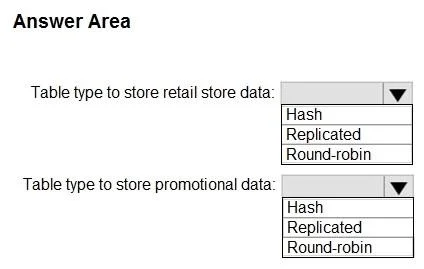
Answer Area
- Table type to store retail store data:HashReplicatedRound-robin
- Table type to store promotional data:HashReplicatedRound-robin
Unlock DP-300 to see the answer
You've previewed enough free DP-300 questions. Unlock DP-300 for full answers, explanations, the timed quiz mode, progress tracking, and the master PDF. Question stem and options stay visible so you can still see what's on the exam.
Topics
#Azure Synapse Analytics#Table Distribution#Data Warehousing#Query Performance