
DP-300 · Question #438
Drag and Drop Question You have an Azure subscription that contains a virtual network named VNet1 and two SQL Server on Azure Virtual Machines instances named SQLVM1 and SQLVM2. SQLVM1 and SQLVM2…
The correct answer is CREATE MASTER KEY; CREATE CERTIFICATE WITH SUBJECT; BACKUP CERTIFICATE; CREATE CERTIFICATE FROM FILE; CREATE ENDPOINT. The correct sequence follows the logical dependency chain required to set up certificate-based authentication for a domain-independent availability group. You must first CREATE MASTER KEY to encrypt the database master key, then CREATE CERTIFICATE WITH SUBJECT to generate a…
Question
Exhibit
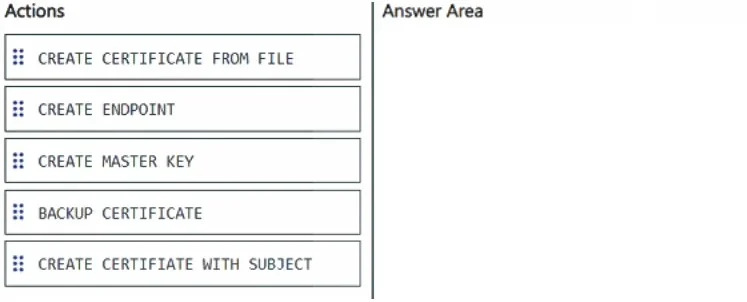
Answer Area
Drag items
Correct arrangement
- CREATE MASTER KEY
- CREATE CERTIFICATE WITH SUBJECT
- BACKUP CERTIFICATE
- CREATE CERTIFICATE FROM FILE
- CREATE ENDPOINT
Explanation
The correct sequence follows the logical dependency chain required to set up certificate-based authentication for a domain-independent availability group. You must first CREATE MASTER KEY to encrypt the database master key, then CREATE CERTIFICATE WITH SUBJECT to generate a self-signed certificate on the first instance, then BACKUP CERTIFICATE to export that certificate to a file so it can be shared with the second SQL VM, then CREATE CERTIFICATE FROM FILE on the second instance to import the certificate from the first VM (enabling mutual trust), and finally CREATE ENDPOINT to create the database mirroring endpoint that uses the certificate for authentication. Each step is a prerequisite for the next, as the certificate must exist before it can be backed up, and the endpoint cannot be created without the certificate infrastructure in place.
Topics
Community Discussion
No community discussion yet for this question.